



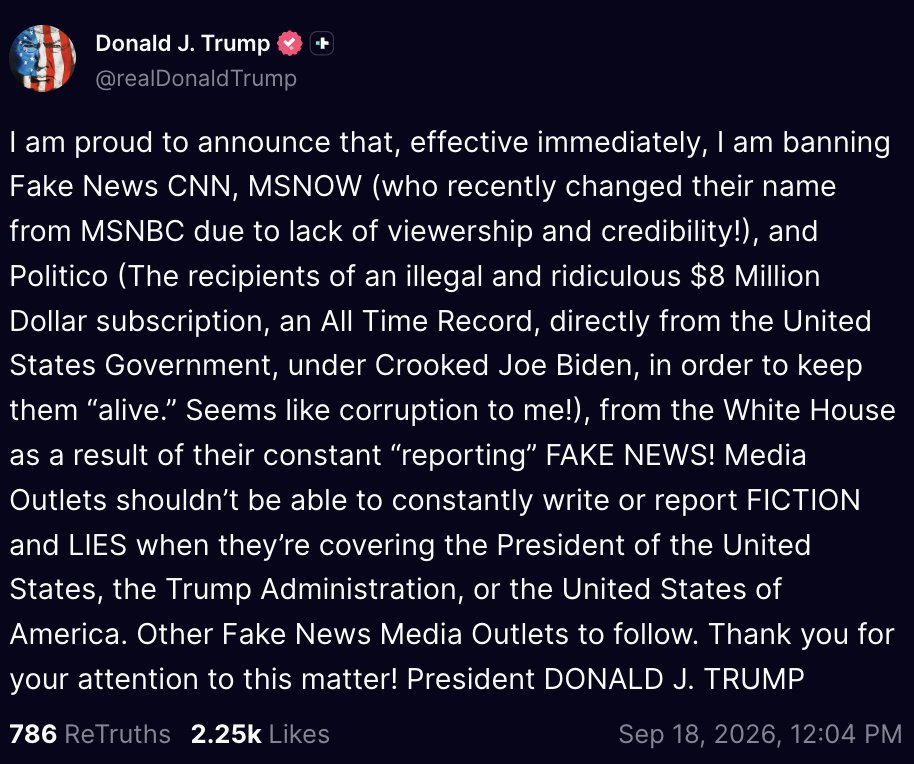
Donald Trump kicked three major news organizations out of the White House.
Now they are asking a federal judge to let them back in.
CNN, Politico and MS NOW announced Monday that they are suing the Trump administration after their White House credentials were revoked and their reporters were denied access to the complex. The organizations argue the ban was retaliation for coverage the president dislikes and therefore violates the First Amendment.
So the story has officially moved from Trump posting about “fake news” to lawyers filing things.
The lawsuit follows Trump’s announcement that the three outlets would no longer be allowed into the White House because, in his view, their coverage contains “fiction and lies.” Reporters from the organizations were subsequently turned away. Politico said one of its journalists had a credential confiscated after it stopped working.
The news organizations say the sequence is exactly the problem.
Their argument is not that every news outlet has an unlimited constitutional right to stand anywhere it wants inside the White House. The government obviously controls access to secure federal property. The argument is that once the White House creates a credentialing system for journalists, it cannot selectively punish particular outlets because the president dislikes what they publish.
That concept has a legal name: viewpoint discrimination.
It also has a very easy-to-understand version: you cannot hand out press passes based on whether the coverage makes the president happy.
The administration has defended the move by insisting that what Trump is targeting is not criticism but “fake news.” Trump has simultaneously said he supports a free press while arguing that outlets he believes repeatedly publish false information should not receive White House access.
That sounds simple until someone has to decide who gets to define “fake.”
If the answer is the person being covered, the White House briefing room can turn into a customer-review program very quickly.
The lawsuit is therefore about much more than whether three particular logos get back through the gate. Press organizations and First Amendment advocates say the precedent would give presidents broad power to reward friendly coverage and punish hostile coverage by controlling physical access to the presidency.
The White House, meanwhile, has significant authority over logistics, security and the size of the press corps. Space is limited. Access rules exist. Presidents have always had tense relationships with journalists. None of that is new.
What is unusual here is how explicit the stated reason for the ban has been.
Trump did not announce a neutral restructuring of credential rules that happened to affect CNN, Politico and MS NOW. He publicly named the organizations, attacked their reporting and announced they were banned. That direct connection between criticism and lost access is likely to become central to the case.
There is already legal history hovering over the dispute.
During Trump’s first term, CNN successfully challenged the suspension of correspondent Jim Acosta’s White House credential. Courts have also ruled in other cases that the government needs fair procedures when revoking press access and cannot simply use credentials as a punishment without constitutional constraints.
More recently, the Associated Press fought the Trump White House over access restrictions tied to the news organization’s editorial decision to continue using the name “Gulf of Mexico” after Trump renamed it the “Gulf of America” for federal purposes. That case also raised the question of whether presidential access can be conditioned on editorial choices.
In other words, Washington is developing a surprisingly extensive body of law around the question: how mad can a president get at a newsroom before the Constitution gets involved?
CNN, Politico and MS NOW say the answer has now been crossed.
Associated Press reporting says the lawsuit includes three correspondents affected by the ban and asks a federal court to restore access. The White House Correspondents’ Association has also condemned the restrictions and called for the journalists’ credentials to be restored.
The administration has not backed away. Trump has treated the restrictions as a direct response to what he says is dishonest reporting and has suggested other outlets could face similar treatment.
That possibility is one reason the case matters even if you never watch CNN, read Politico or know what channel MS NOW is on.
A ruling favoring the White House could expand presidential discretion over who receives routine press access. A ruling favoring the news organizations could reinforce limits on using access as leverage over coverage.
And because presidents change while precedents stick around, the rule created here would not belong only to Trump.
Imagine a future Democratic president banning Fox News because the White House believes its coverage is dishonest. Or a Republican president banning a newspaper after an investigation the president says is false. Or any administration deciding that reporters can enter only if their employer meets the government’s preferred standard of fairness.
That is why this fight gets complicated fast. People can dislike a news outlet, distrust its reporting, complain about bias and still care about whether the government gets to decide which journalists are sufficiently agreeable to enter the building.
The lawsuit will now force a judge to separate two powers that are both real: the White House’s ability to manage access to a secure government facility and the press’s constitutional protection from government retaliation based on what it publishes.
Trump has made his position unusually easy to identify. He thinks these outlets publish fake news, so he does not want them inside.
The outlets have made theirs equally clear.
See you in court.
Should a president ever be able to revoke a news outlet’s White House access because he believes its coverage is false or unfair?