




The Cold War had the famous Washington-Moscow hotline.
The AI age may be getting its own version.
U.S. officials have proposed creating a direct emergency communication channel with China that the two governments could use during a major artificial-intelligence-related national-security incident.
Think less “the robots are calling” and more “something just happened with an AI system and the two most powerful countries on Earth need to talk before everyone assumes the worst.”
Business Insider reports that Treasury Secretary Scott Bessent discussed the concept with Chinese Vice Premier He Lifeng during recent talks in New York. The proposed mechanism is being described as an AI-era “red phone,” borrowing the shorthand used for the communications systems built to reduce the risk of catastrophic misunderstanding between nuclear powers.
China has not publicly signed on.
But the fact that officials are discussing such a channel tells you where the AI conversation has gone.
A few years ago, national arguments about artificial intelligence mostly sounded like: Will ChatGPT take my job? Can students use this on homework? Why does every company suddenly have an AI button?
Now governments are talking about crisis hotlines.
The core problem is not necessarily a rogue superintelligence deciding to launch something on its own. The more immediate concern is misunderstanding.
Imagine a powerful AI system being used in a major cyberattack. Or an automated defense tool behaving unexpectedly. Or one country detecting activity that appears to originate from the other side but cannot immediately determine whether it was intentional, accidental or even state-directed.
In a high-tension U.S.-China relationship, uncertainty can become escalation very quickly.
A direct channel could give officials a way to say: “Was this you?” before responding on the assumption that it was.
That basic logic is familiar from nuclear diplomacy.
The original U.S.-Soviet hotline was created after the Cuban Missile Crisis exposed how dangerous slow and indirect communication could be during a confrontation between nuclear powers. Contrary to decades of movie imagery, it was not initially a red telephone sitting on the president’s desk. It was a secure communications link designed to move messages quickly between governments.
The AI version would serve a similar conceptual purpose: reduce the chances that technical uncertainty turns into geopolitical panic.
There is a major catch.
The United States and China do not trust each other very much on AI.
Washington worries that China could gain military and economic advantages from advanced American technology. The U.S. has restricted exports of high-end chips and other technologies. American officials have accused Chinese companies of misusing U.S. AI systems, while Beijing has accused Washington of trying to contain China’s technological rise.
At the same time, both countries are developing increasingly powerful systems whose effects may not stop politely at national borders.
That leaves everyone in an awkward spot.
You can view the other country as your biggest AI competitor and still need its phone number when something catches fire.
Associated Press reporting on the broader U.S.-China AI relationship describes both governments as struggling with exactly this contradiction. Cooperation on AI safety may be necessary because the two countries are the dominant global powers in advanced AI, but each side worries that safety agreements could become a strategic disadvantage.
If the United States slows development and China does not, American officials fear falling behind.
If China agrees to restrictions that the U.S. does not honor, Beijing faces the same problem.
And if neither country coordinates on anything, both could be left guessing during a crisis involving technology that moves far faster than traditional diplomacy.
Hence: red phone.
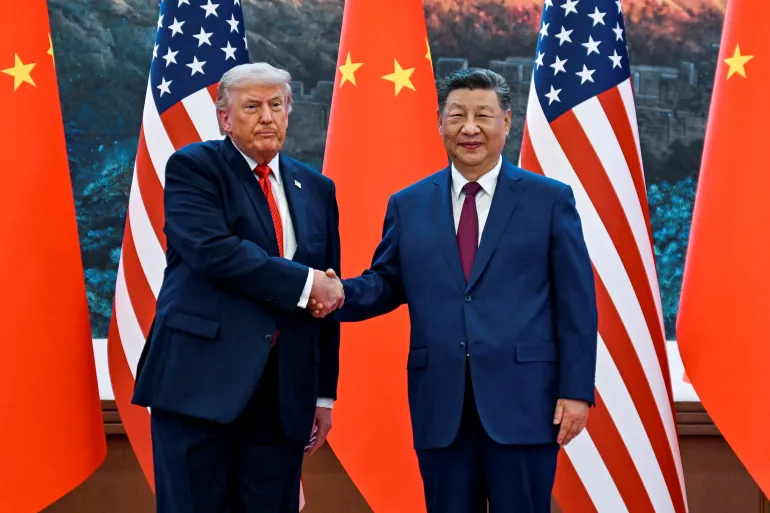
The proposal also arrives as President Trump prepares to meet Chinese President Xi Jinping in Washington. AI is expected to be one of the subjects hanging over the broader U.S.-China relationship, alongside trade, semiconductors, tariffs and security.
Business Insider reports that the emergency mechanism was discussed as part of a wider U.S.-China AI dialogue aimed at transparency and crisis management. Chinese state media described recent talks as constructive but Beijing has not publicly committed to the hotline proposal.
There are obvious unanswered questions.
What counts as an AI emergency?
Who gets to use the channel?
Would governments be required to disclose incidents involving private AI companies?
How much technical information would either side be willing to share?
And perhaps most importantly: would either side believe what the other says during an actual crisis?
A hotline only works if someone picks up and both sides believe there is value in talking.
Still, the proposal is a revealing milestone.
Governments are beginning to treat AI not merely as a commercial technology but as something that may require the same kinds of international guardrails used for military and strategic risks.
That does not mean AI is equivalent to nuclear weapons. It means policymakers increasingly believe certain AI incidents could move quickly enough, cross borders easily enough and create enough uncertainty that a direct emergency line could be useful.
And that is a pretty dramatic evolution from “write me an email.”
If the hotline happens, it may never be used. That would probably be the ideal outcome.
But the fact that the United States wants to build it says something important about where officials think this technology is heading.
The AI race is no longer just about who builds the best model.
It is also about what happens when something goes wrong and the two countries building the most powerful systems have about five minutes to decide whether they are looking at an accident, an attack or something nobody planned for.
Would an AI emergency hotline make the world safer, or would the U.S. and China still be too suspicious of each other for it to work when it actually matters?