



Reporter Andrew Feinberg challenged Trump’s new fraud-reward program in the Oval Office. Trump warned him to “be careful,” later called him a “sick person,” and the White House’s online operation escalated the fight afterward.
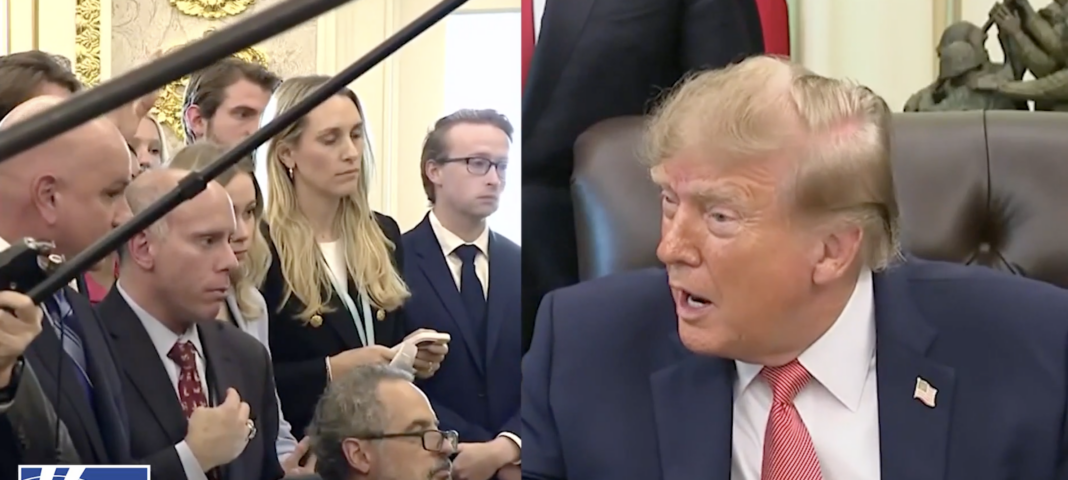
An Oval Office event about fighting government fraud somehow ended with Donald Trump warning a reporter to “be careful,” asking whether he was a “sick person,” JD Vance calling him an “imbecile” and an official White House account escalating the attack online. It was a remarkably efficient demonstration of how quickly a policy rollout can become a personnel feud.
The clash began when Andrew Feinberg, The Independent’s White House correspondent, questioned Trump and Vance about a new fraud-reporting reward program. The administration is offering tipsters up to $30,000 for information that leads to successful fraud cases.
Feinberg pointed out that an existing law, the False Claims Act, can already allow whistleblowers to receive a much larger share of recovered government money in qualifying cases. His question was essentially why a person with strong evidence would choose the new program if an older law could pay significantly more.
Trump did not particularly enjoy the comparison. During the exchange, he pointed toward Feinberg and said, “I don’t know who the hell you are, but you better be careful.”
Feinberg responded online with the kind of detail designed in a laboratory for viral political social media: he said he had told Trump exactly who he was less than five minutes earlier. Nothing makes an ominous presidential warning less tidy than the target replying with a timestamp.
Vice President JD Vance jumped into the policy argument and accused Feinberg’s question of being fundamentally dishonest. Vance later amplified video of the confrontation on social media and referred to the reporter as an “imbecile.”
The exchange did not end there. When Feinberg tried to ask another question later in the Oval Office session, Trump ordered him to be quiet, asked what was wrong with him and then asked whether he was a “sick person.”
Feinberg said afterward that he was simply doing his job. In a first-person account for The Independent, he described how a technical question about whistleblower incentives turned into a personal confrontation with the president and his team.
Then the White House’s online response made the situation uglier. The administration’s Rapid Response account used a derogatory disability slur to attack Feinberg, according to The Daily Beast and Feinberg’s own account.
The slur drew criticism not just because it was personal but because it targeted people with developmental disabilities as an insult. The White House did not publicly identify who authored the post when reporters asked about it.
The policy dispute underneath all of this is actually fairly technical. The False Claims Act, which dates to the Civil War era, allows private individuals in certain fraud cases to bring claims on the government’s behalf and potentially receive a percentage of the recovery.
The administration argues its new reward program addresses fraud that may not fit neatly into the older law and gives ordinary people a simpler mechanism to submit tips. Feinberg’s question challenged whether the smaller reward might make the new system less attractive in cases where the False Claims Act applies.
That is the sort of disagreement that could have produced a dull paragraph about statutory coverage. Instead, it produced a president pointing at a reporter, the vice president insulting him online and an official White House account reaching for a slur.
Trump has had hostile exchanges with reporters for years, and his supporters often view those confrontations as proof that he refuses to tolerate what they see as biased coverage. Critics see the rhetoric as increasingly threatening, especially when the president tells a journalist to “be careful” in response to an ordinary policy challenge.
No matter which interpretation someone prefers, the rollout achieved something impressive: almost nobody is talking about the fraud hotline anymore. The White House launched a program to reward whistleblowers and somehow made the biggest story the way it treated the guy asking how the rewards actually work.