



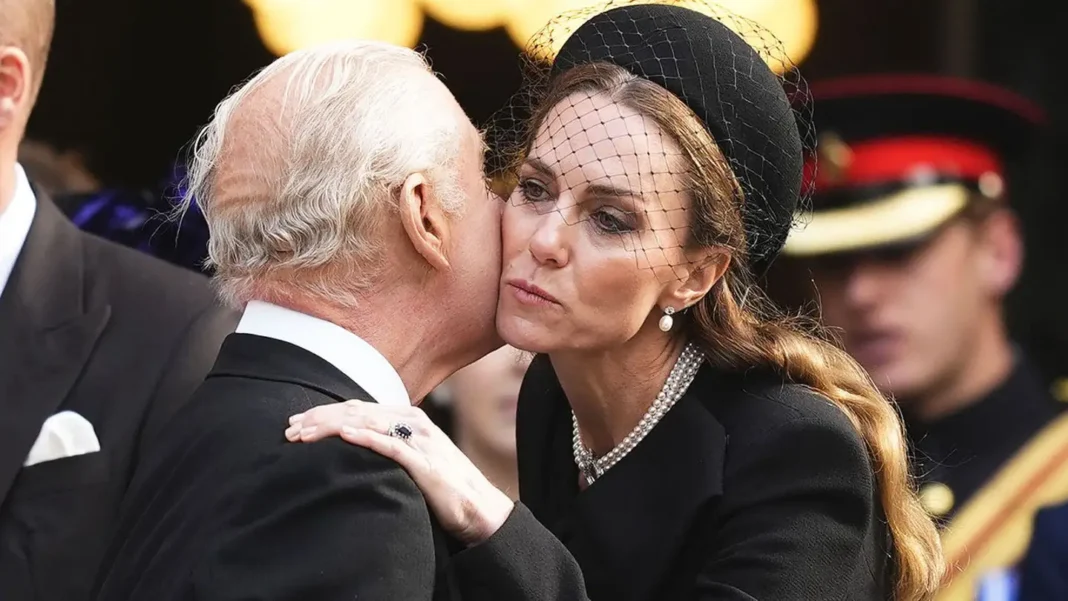
Royal expert Katie Nicholl told Fox News this week that Kate Middleton is “the monarchy’s greatest asset” and described her as “indispensable” to an institution that is facing what Nicholl characterizes as “mounting pressure” as it operates with a slimmed-down working core, a king managing cancer, an estranged brother conducting media operations from California, and a line of succession whose working members thin out dramatically after position four. Royal author Sally Bedell Smith told People magazine that Kate is “like the daughter he never had” to Charles. “He has always had a very strong bond with her,” Smith said. “He shares with William an impulse to protect her.” The impulse is mutual and documented. The cancer diagnoses that both experienced in the same year produced a proximity and a shared experience that the institution has quietly incorporated into its public communications strategy.
Kate completed her cancer treatment earlier this year, returning to public duties in the spring and summer of 2026 with a schedule that has been carefully graduated from minimal to substantial. The Trooping the Colour appearance in June, where she stood on the Buckingham Palace balcony with Charles, Camilla, William, and the three children while the crowd below cheered, was the public marker of a return that the Palace had been preparing for months. She delivered her first public speech since her diagnosis at the Kensington Palace garden party in April. She attended Commonwealth Games events with William and the children last month. The graduation back into full royal duty has been managed with the kind of communications precision that the institution deploys when the stakes are highest, which is to say that her return has been presented as a triumph rather than as the end of a medical ordeal.
The “indispensable” characterization is worth examining against the institution’s actual working structure, because the word carries analytical weight beyond sentiment. The British monarchy’s working members, the people who carry out public engagements, attend official functions, represent the Crown at ceremonial events, and provide the visible continuous presence of the institution in public life, are, at this moment: King Charles, Queen Camilla, Prince William, Princess Kate, Princess Anne, Prince Edward, Sophie the Duchess of Edinburgh, and the Duke and Duchess of Gloucester, with various others appearing at lower-frequency engagements. That is the entire working core. Charles has cancer and a graduated schedule. Camilla has stepped into a more prominent role than she held as Duchess. Anne carries out more than 300 engagements per year at 75. Edward and Sophie are reliable but lower-profile.
Kate is, within that structure, the face of the next generation of the monarchy. William’s relationship with the press has been consistently described as tenser and more guarded than Kate’s. His public approval ratings are strong but his relationship with the media that constructs the monarchy’s public image is one he manages rather than cultivates. Kate has historically been the Wales family’s point of public warmth, accessible enough to connect with the public at a personal level while maintaining the decorum the institution requires. Royal author Tom Quinn told Fox News that “not since Diana has any royal generated such affection and public warmth as Catherine.” The comparison is the one that carries the most weight in British royal commentary. It is also the comparison that comes with the most complicated history, given what Diana’s public warmth did to the institution from the inside.
The Fox News reporting notes that royal watchers and commentators are monitoring the “slimmed-down monarchy” with concern about whether the working core is large enough to sustain the institution’s public commitments. The concern is structural: the monarchy is by design smaller than it was under Elizabeth II, who retained a larger extended working family and distributed the ceremonial load more widely. Charles and William have both indicated a preference for a compact working institution rather than a large extended one. Harry’s departure removed two working members. Andrew’s removal removed another. Beatrice and Eugenie were never formal working members. The compact model works when all of its components are healthy and present. Kate’s cancer year demonstrated what happens when one of its central components is not.
She is back. The institution is calling her indispensable. The monarchy needs the assessment to be accurate.
When royal experts call Kate Middleton indispensable to a monarchy that is already operating with its thinnest working core in decades, what exactly happens if the assessment proves correct?
Sources