



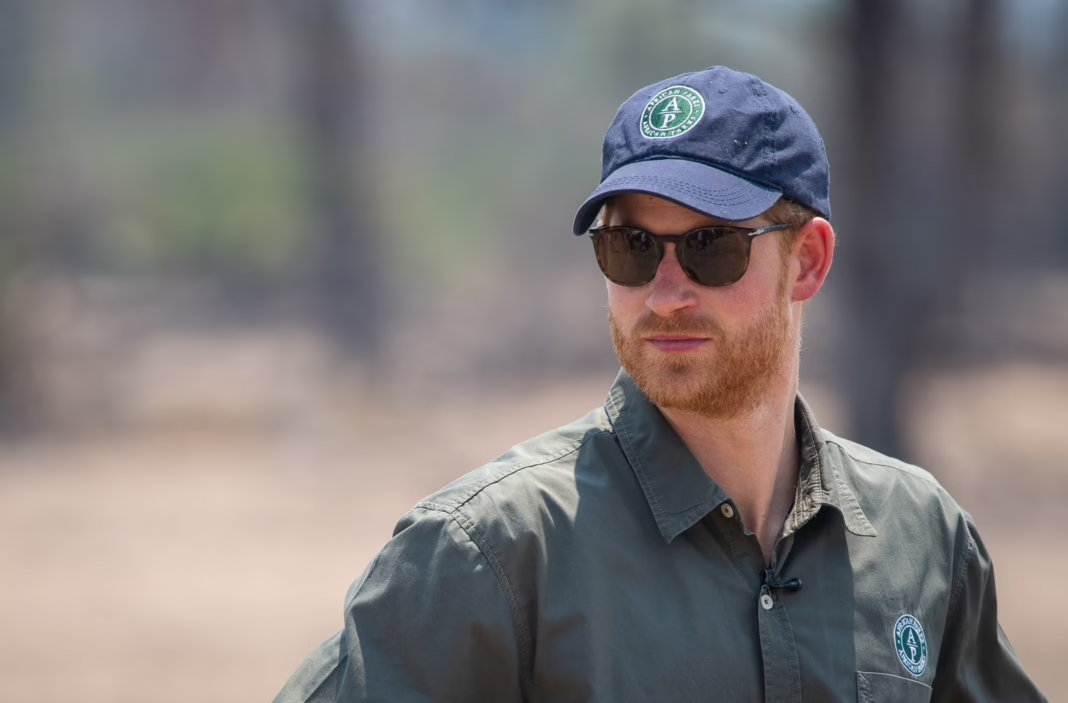
Prince Harry is coming back to Britain with less luggage and, apparently, one fewer board meeting. On Monday, the Duke of Sussex stepped down from the board of African Parks, the conservation organization he had been involved with for years. The departure arrives just as Harry and Meghan prepare for an extended return to the UK, which is convenient timing if your family move already has enough boxes labeled “complicated.” African Parks is not a ceremonial patronage Harry occasionally remembered at Christmas. He became its president in 2017 and later joined the board, so leaving now closes a substantial chapter in his post-royal public life.
The reason this matters is not that a famous prince changed his LinkedIn. African Parks has been dealing with allegations of serious human-rights abuses by rangers associated with its operations. The Guardian reported Monday that Harry’s spokesperson said he remains an “active and avid supporter” of the charity’s mission even after leaving its board. Page Six likewise reported his departure and noted that the organization has acknowledged past abuses and pledged reforms. That creates the sort of royal sentence Britain has perfected over centuries: he has left the institution, remains devoted to the institution, and would very much like everyone to understand that those are not contradictory positions.
Harry has spent much of his adult public life trying to separate service from status. That was central to the Sussex pitch after leaving working royal duties in 2020. The couple could surrender the palace machinery, the theory went, while keeping the causes, platforms and charitable work that gave their public lives meaning. African Parks fit neatly into that model. It was international, serious and attached to Harry long before the current UK-return saga. His exit therefore lands differently from a canceled podcast or a television deal. This is the kind of work that was supposed to prove the public-service part of the Sussex project could survive outside the monarchy.
The problem with building a public identity around causes is that causes eventually require governance. Celebrity can attract money, cameras and attention, but a board seat is supposed to come with oversight. African Parks said an internal review identified failures and the organization has promised changes. Harry’s departure does not establish personal responsibility for alleged abuses, and the reporting does not support saying that it does. It does, however, expose the uncomfortable difference between lending a famous name to a mission and being attached to an institution when that institution faces difficult questions. Royal-adjacent philanthropy is glamorous right up until somebody asks for the minutes.
The timing makes the story especially awkward. Harry and Meghan are preparing to spend an extended period in Britain while remaining non-working royals. Their return has already generated stories about schools, security, housing, acting, brands and whether Britain is about to get a new category of royal life that is private except for all the parts conducted in public. Now Harry arrives having stepped away from a major charity role. That does not mean the move caused the resignation. It means the return narrative has acquired another loose thread before the family has finished unpacking.
There is a broader lesson here for the modern royal economy. Working royals inherit institutions. Ex-working royals have to assemble portfolios. Every charity, production deal, lifestyle company and advocacy role becomes part of the answer to the question, “What do you actually do now?” Harry has had a clearer answer than most because the Invictus Games and long-running charitable commitments gave him something more durable than celebrity. Losing one of those commitments makes the portfolio smaller, and it makes scrutiny of the remaining pieces larger. Reinvention is much easier when the old job came with castles and nobody expected quarterly deliverables.
None of this makes Harry’s decision inherently wrong. Leaving a board can be appropriate when an organization is under pressure, when responsibilities change or when a person believes a different relationship is better. The verified reporting gives us no basis to assign a hidden motive. The satire is in the public choreography. Six years after leaving royal duty to build an independent life, Harry is returning to Britain while simultaneously reducing one of the independent roles that helped define that life. The Sussex story keeps moving forward by somehow circling back to the same question: what does a prince without a royal job want his public job to be?
The monarchy has always been good at making continuity look effortless because the institution remains even when individual royals change jobs. Harry does not have that luxury anymore. His independent public life has to be built from separate organizations, each with its own leadership, controversies and expectations. That is freedom, but it is also administration. The palace may have been constraining, yet it came with an entire machine designed to make a royal role look permanent. Outside it, permanence has to be earned contract by contract and cause by cause.
That is why the charity departure is more than celebrity housekeeping. Harry has repeatedly presented service as the durable part of his identity, the thing that survives changes in title, geography and palace status. When one of those service roles ends, the public naturally asks whether it is a routine transition or part of a larger narrowing of commitments. The available reporting does not answer that question, so the article should not pretend it does. What it does show is a prince arriving back in Britain with a public life that is being edited in real time, one institution at a time.
If Harry is returning to Britain as a private citizen with a public platform, which parts of his post-royal life are actually coming back with him?
Sources
The Guardian: Prince Harry quits board of wildlife charity after human rights abuses
The Guardian: Is this the end of Harry and Meghan’s American dream?
Page Six: Prince Harry steps down from longtime charity embroiled in human rights violations scandal ahead of UK move