



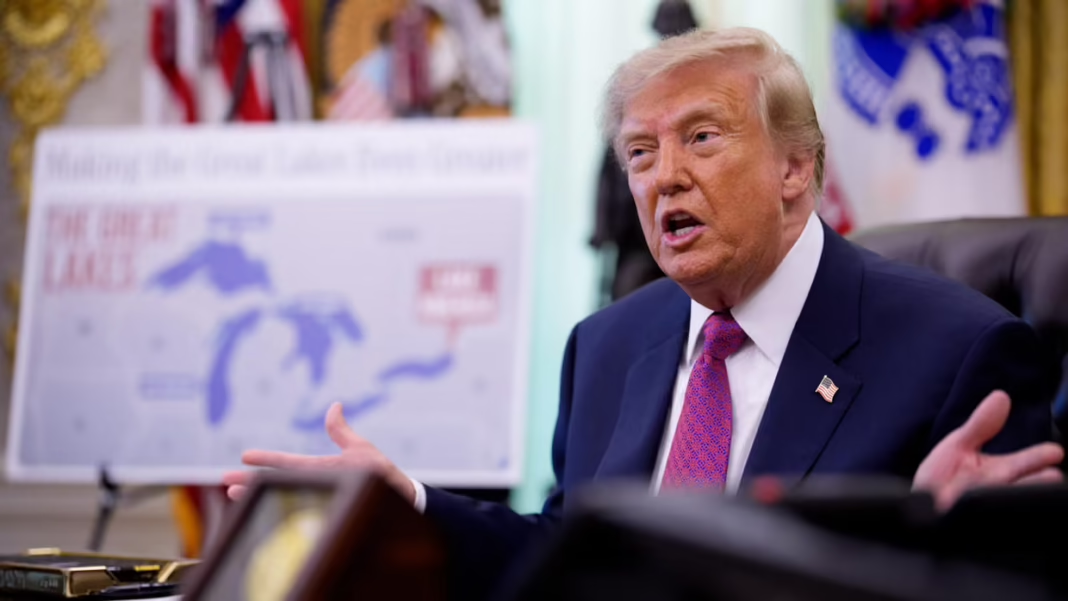
Donald Trump signed an executive order renaming Lake Ontario as Lake America on US federal maps, turning a trade fight with Canada into a cartography project. The New York Post reported that Trump said the change was effective immediately while criticizing Canadian trade policy and calling Canadian officials “nasty.” Canada’s prime minister, Mark Carney, rejected the move, as did New York Gov. Kathy Hochul. The Great Lakes have survived glaciers, industrialization and zebra mussels. They have now reached branding season.
There is also a jurisdictional comedy built into the stunt. Lake Ontario is shared by the United States and Canada. Washington can tell federal agencies what terminology to use. It cannot make Canadians forget the name of the lake outside their windows. The result is less a geographic change than a federally mandated nickname, which is exactly the sort of distinction Trump’s political style tends to treat as an invitation rather than a limitation.
The move follows Trump’s earlier renaming of the Gulf of Mexico as the Gulf of America. He has also floated changing the names of the Atlantic and Pacific oceans. The Lake Ontario order arrived amid escalating tariffs and retaliation between the United States and Canada. In other words, a dispute over trade barriers now has a commemorative body of water. This is diplomacy with a gift-shop strategy.
The Trumpiverse target is the president’s inability to leave a conflict at the level where it started. A tariff disagreement cannot merely be a tariff disagreement. It has to become a test of national respect, then a personal feud, then a naming ceremony. The map itself must choose sides. Somewhere, a federal employee is updating a database because two governments disagree about commerce.
The naming campaign works because it is simple, visual and impossible to ignore. Trade policy is complicated. Supply chains are dull. Tariff schedules do not fit nicely on a hat. Lake America does. It converts an argument about economic policy into a loyalty test that can be repeated on television in two words. That is efficient politics even when it is ridiculous governance.
The risk is that symbolic escalation makes practical compromise harder. Once a lake name becomes part of the fight, backing down on tariffs can be sold as backing down on national pride. Canada has its own domestic politics and has announced retaliation. Michigan and other border economies are deeply tied to Canadian trade. None of those businesses receives a discount because the map now sounds more patriotic.
The name itself is also a perfect Trump object because it is simultaneously consequential and unserious. Federal maps, documents and agencies may change terminology. Canadians will not. Americans living along the lake may not. Media outlets will choose their own style. The result is a linguistic border dispute layered onto the actual border dispute. Everybody can participate without moving a single shipping container.
Trump has always understood that naming is power. Buildings, products, slogans and opponents all become easier to dominate once he has assigned them a label. Applying that instinct to geography turns the landscape into another campaign surface. The Gulf of America established the pattern. Lake America suggests the pattern can continue whenever a place is prominent enough to carry a message.
The practical question is whether the stunt helps him in the trade fight. It may delight supporters who enjoy the provocation. It may irritate Canadians who already view the tariffs as coercive. It may do absolutely nothing to lower costs or reopen negotiations. Symbolic politics can be useful, but symbols do not clear customs.
The reason trump renamed lake ontario because apparently geography reports to him works as more than a one-day headline is that the underlying incentive does not disappear when the news cycle moves on. The people and institutions involved are being rewarded for a particular kind of behavior, whether that reward is attention, political loyalty, money, status or the comfort of avoiding a harder decision. That is the thread worth watching after the immediate controversy cools. A single episode can be dismissed as bad luck or bad optics. A repeated incentive becomes a governing or cultural habit. The useful test is not whether everyone involved can produce a defensible explanation. Most public controversies come with one. The useful test is whether the explanation would still sound reasonable if the names and teams were reversed. That is where satire earns its keep. It strips away the jersey and leaves the behavior sitting there by itself. The next development will matter because it will show whether this was an exception that embarrassed the people involved or a model they intend to keep using. If the same logic appears again, the story stops being an oddity and becomes a pattern. If the people involved change course, that is evidence too. That is why the closing question matters here: If Trump can turn a trade dispute into a federal naming campaign, what American landmark is supposed to feel safe from the next argument? Public life is full of arguments about motives that cannot be proved. Behavior is easier to judge. Watch what gets repeated, what gets rewarded, what gets quietly abandoned, and who is asked to absorb the cost. Those details usually tell the story more clearly than the slogans do.
If Trump can turn a trade dispute into a federal naming campaign, what American landmark is supposed to feel safe from the next argument?
Sources
New York Post: Trump signs executive order renaming Lake Ontario to Lake America ‘effective immediately’ – in jab to ‘nasty’ Canada
The Guardian: Canadian prime minister and New York lawmaker denounce Trump’s move to rename Lake Ontario as Lake America – as it happened