



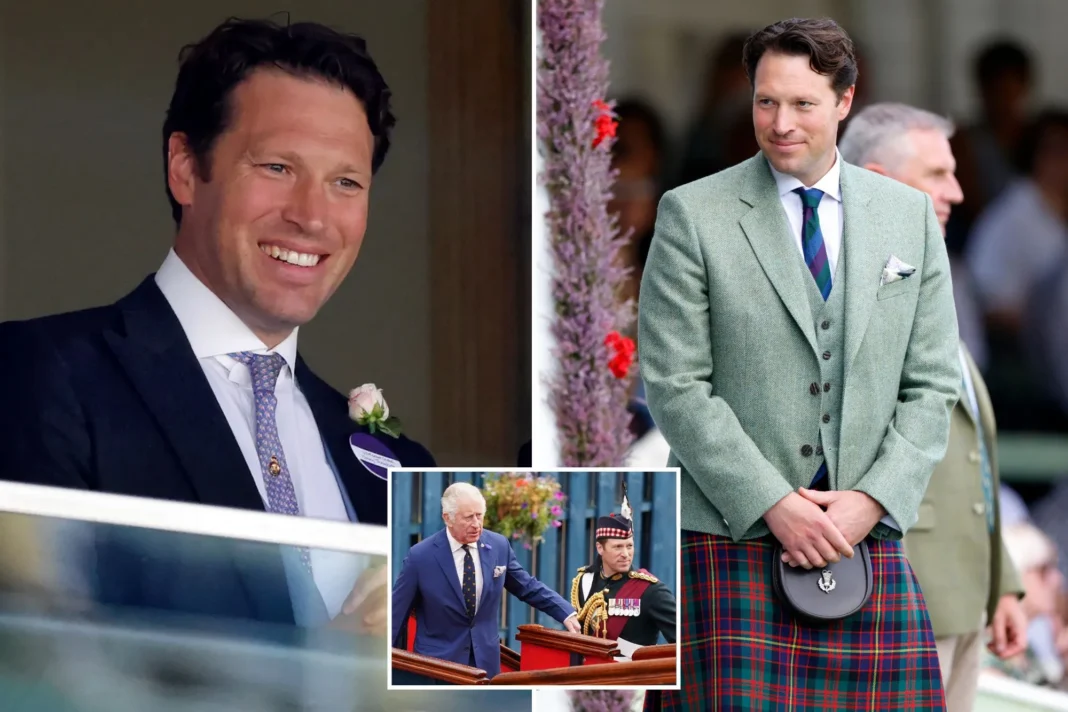
King Charles has a staffing problem, which is an inconvenient thing for an institution whose entire public image depends on appearing as though nobody ever has one. Lieutenant Colonel Jonny Thompson, the King’s senior equerry and one of the most recognizable members of the royal household, is leaving both the palace operation and the British Army at the end of the year. The Sun reported the departure this week, complete with the detail that Thompson had acquired an online following large enough for the internet to give him the sort of nickname normally reserved for a supporting actor on a streaming drama. Buckingham Palace, more sensibly, thanked him for seven years of service. The real story is not that a popular aide is moving on. It is that another person who helps make the monarchy look seamless is walking toward the exit.
Thompson’s job was never merely to stand near the King in an excellent uniform. He joined the Royal Household in 2019 as equerry to the then Prince of Wales and Duchess of Cornwall, became the King’s equerry after Charles took the throne in 2022, and was later promoted to senior equerry. His work put him beside the sovereign during ceremonies, state occasions and the routine choreography that makes a monarchy look less like a complicated workplace and more like a centuries-old machine that wakes up every morning already knowing where the cars are. He also served in Iraq and Afghanistan and commanded a company in the Royal Regiment of Scotland. That is rather more substantial than the social-media version of his résumé, which mostly noticed the kilt.
His departure would be ordinary on its own. People leave jobs. Even jobs involving palaces eventually produce farewell emails. The timing is what makes it interesting. Sir Clive Alderton, the King and Queen’s principal private secretary, announced in July that he will step down around his 60th birthday next May after roughly two decades in the Royal Household. The Independent described Alderton as Charles’s most senior aide. The Sun called Thompson the third major aide to leave the King in recent months and also reported that long-serving butler Bernie Flannery had stepped down. One exit is turnover. Several exits close together start to look like the royal household has discovered LinkedIn.
The palace insists there is no ambush here. A spokesman said Charles and Camilla knew about Thompson’s plan in advance and were grateful for his support. Alderton has likewise described his departure as a planned transition and said he would continue helping the King and Queen in a less formal capacity. There is no verified evidence of a revolt, a feud, a collapse or any other word a tabloid headline would enjoy putting in capital letters. That restraint matters. The absurdity is more mundane. The monarchy sells permanence, but the permanence is administered by employees with retirement dates, Army careers, spouses, calendars and perfectly understandable desires to do something else.
This is the part of royal life the pageantry tends to hide. A king does not simply arrive. Somebody has worked out the route, the briefing, the timing, the guest list, the order of precedence, the folder, the backup folder and what happens when a visiting president decides to improvise. The crown may be hereditary. Competent logistics are not. Charles can inherit a throne without applying for it, but he cannot inherit a fully trained principal private secretary every time one leaves. At some point even a thousand-year institution has to recruit.
That makes the current churn especially awkward because Charles is still running a relatively young reign with a relatively old institution. He became King in 2022 after spending decades preparing for the role, but preparation is not the same as having the same operating team forever. Alderton helped manage the transition from Prince of Wales to sovereign. Thompson became one of the visible fixtures of the new court. Losing experienced aides does not mean the monarchy is in crisis. It does mean the people who know how Charles likes the machinery to run are beginning to change, and institutions often discover how much knowledge was living inside individual humans only after those humans leave the building.
Royal coverage encourages the opposite impression. The public sees the King at a cathedral, a state banquet or a garden party and is invited to study the tie, the handshake and whether somebody stood half a pace too close to somebody else. Behind that photograph is a workforce whose success is measured partly by whether anyone notices it exists. That is a difficult business model. Do the job perfectly and the institution appears effortless. Leave, and suddenly everyone remembers there was a job. Thompson became unusually visible because the internet noticed him. Most of the machinery never gets that courtesy.
There is also a useful lesson here for the monarchy’s habit of turning continuity into a brand. Continuity is real. Charles inherited a constitutional role that existed long before any current staff member was born. But continuity is maintained through constant replacement. New private secretaries. New equerries. New advisers. New people learning which doors open, which traditions matter and which traditions matter mainly because everyone is too nervous to be the first person to stop doing them. The crown survives because the staff changes. The palace just prefers not to put that sentence on the souvenir tea towel.
None of this requires Thompson or Alderton to stay forever. In fact, a healthy institution should be able to lose important people without wobbling. That is the test now. Charles has spent his reign trying to present a monarchy that is slimmer, steadier and capable of carrying on through family dramas, political change and the occasional visiting president offering unsolicited advice about his children. A streamlined monarchy sounds efficient until several experienced operators leave and the streamlining starts to resemble fewer people carrying the same silver trays.
The palace will appoint replacements. Ceremonies will happen. Cars will arrive. The King will continue appearing in rooms at the exact moment the programme says he should, which is the closest thing the British state has to proof that somebody, somewhere, made a spreadsheet. But the exits are a reminder that royal mystique depends heavily on ordinary professional competence. The monarchy can keep telling us it is an ancient institution floating serenely above the churn of modern employment. Its HR department may have a more current version of events.
If the monarchy’s greatest trick is making itself look permanent, how many of the people who create that illusion can it replace before the seams start showing?
Sources
The Sun: Hunky aide & bodyguard dubbed ‘King Charles’ hot equerry’ to step down from role… after winning an army of royal fans
The Sun: The King’s right-hand man Sir Clive Alderton steps down 20 years after first joining the Royal Household
The Independent: King’s most senior aide to step down after 20 years with royal household