



The Justice Department is investigating Fox, CNN, ABC, CBS and NBC over their temporary joint suspension of White House pool coverage, examining whether the move amounted to an illegal coordinated boycott.
The Justice Department has opened an antitrust investigation into five of the biggest television networks in America at the same time. The targets are Fox News, CNN, ABC, CBS and NBC — a lineup broad enough that almost every cable-news argument now has at least one participant under federal scrutiny.
The probe centers on the networks’ decision to temporarily suspend participation in White House television pool coverage after the administration barred CNN, MS NOW and Politico from certain access. DOJ officials are examining whether the coordinated suspension could qualify as an unlawful boycott under federal antitrust law.
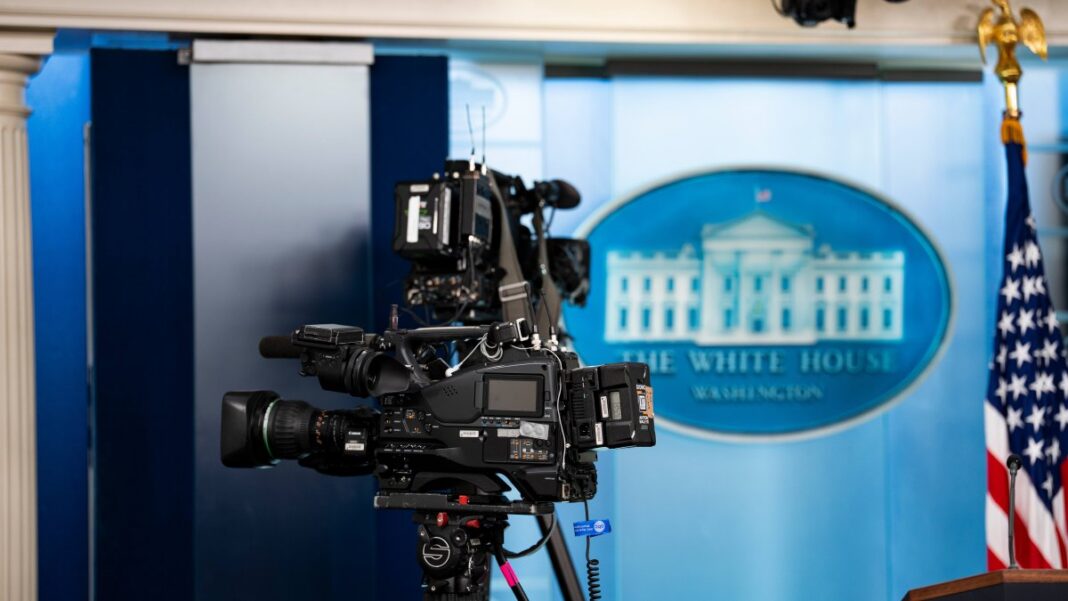
White House pool arrangements exist because not every network can physically place its own camera crew next to the president at every event. Networks rotate responsibilities and share footage, reducing logistical demands while ensuring broad access to presidential activity.
When the White House restricted several outlets, the major television networks temporarily stopped supplying pooled video in protest. Coverage later resumed, particularly after litigation over press access produced a federal-court intervention.
The Justice Department says the coordinated nature of the networks’ response raises a competition question. A DOJ spokesperson told The Washington Post that antitrust officials are reviewing whether the networks effectively acted together to withhold a service rather than making independent editorial decisions.
Press-freedom advocates see the matter very differently. They argue that antitrust law is being stretched into a tool for punishing news organizations that collectively resisted White House access restrictions. Their concern is that the government is not merely regulating market competition but potentially pressuring editorial behavior.
That does not automatically make the investigation illegitimate. Competitors can violate antitrust law when they coordinate conduct that harms competition, even if the companies involved are media organizations. The legal question is whether this particular pool arrangement and temporary suspension fit that framework.
The First Amendment question sits beside it. News organizations routinely cooperate on pool arrangements for practical reasons, and collective decisions involving access can also function as a form of press protest. Sorting out where logistical cooperation ends and unlawful coordination begins is likely to be the heart of the dispute.
The network lineup makes the politics especially odd. Fox News is generally friendlier to Trump than CNN or the broadcast networks, yet it is included in the same probe. That gives the investigation a certain equal-opportunity quality: apparently everyone can get an antitrust letter.
The dispute traces back to the White House’s broader battle with outlets Trump accuses of unfair coverage. CNN, MS NOW and Politico have all faced access restrictions, and the administration has repeatedly argued that the president has broad authority to determine who receives physical access to White House spaces.
Media organizations counter that access cannot be distributed or withdrawn based on viewpoint without raising constitutional concerns. Federal courts have already become involved in portions of that fight, particularly around credential revocations.
The antitrust investigation adds an entirely different branch of law to what was already a messy First Amendment conflict. Instead of simply asking whether the White House can exclude reporters, DOJ is now asking whether networks can collectively respond when that happens.
No network has been found to have violated antitrust law. The investigation is an inquiry, not a judgment, and it could end without charges or enforcement action.
Still, opening a federal competition probe into five major news networks over how they responded to presidential press restrictions is not a routine media-policy disagreement. It guarantees that every DOJ step will be examined for both legal logic and political motive.
Washington has somehow managed to transform the humble press pool — essentially a scheduling system for cameras — into a fight involving the White House, federal judges, five television networks, the First Amendment and the Sherman Act. Nobody can say government is not finding ways to keep the content pipeline full.