



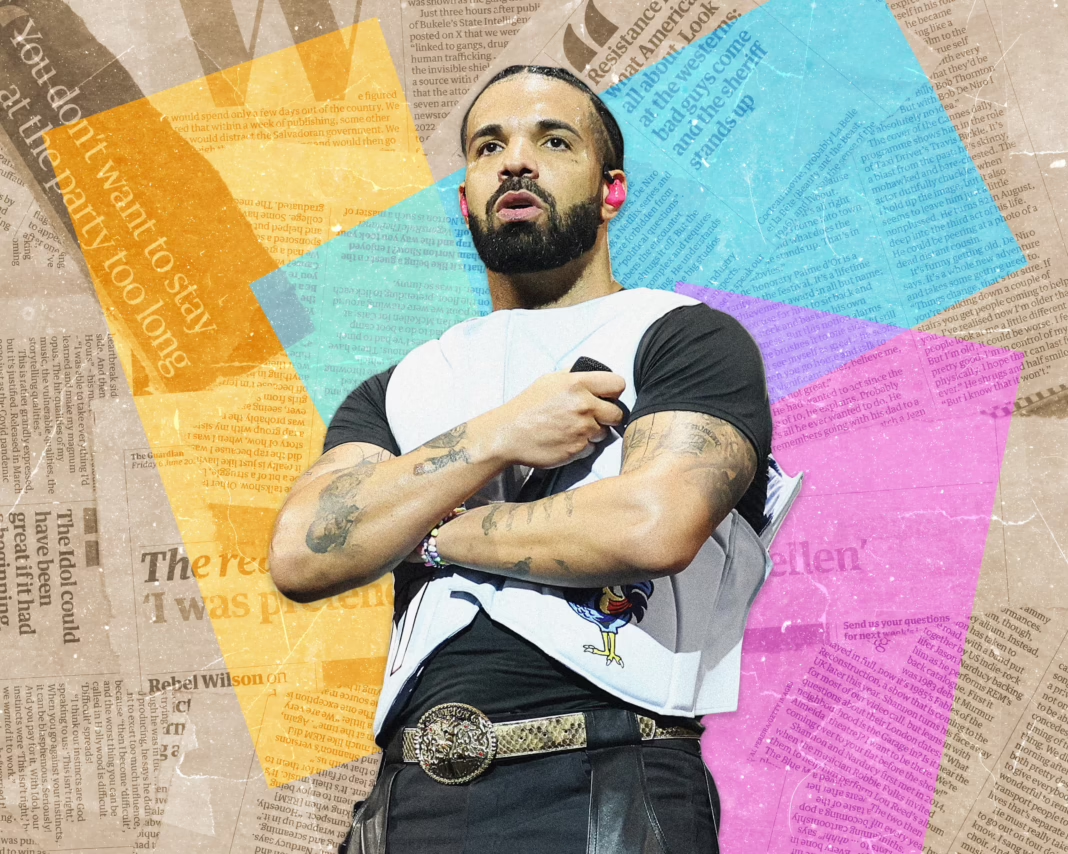
Drake is approaching 40, and apparently the culture has decided the most urgent question is why he is barking like a dog. The Guardian devoted its latest celebrity crib sheet to the rapper’s ‘midlife pivot,’ a package that also touched on gambling and conspicuously public dating. That is less a scandal than a useful snapshot of modern celebrity. A famous person can no longer simply release music, get older and occasionally appear somewhere expensive. Every phase needs a narrative. Every narrative needs clues. Every clue needs six things you need to know before lunch.
The target is not Drake for making odd noises. Pop stars have been strange in public since before microphones improved enough to record it. The target is the celebrity-content machine that turns normal career drift into an unfolding cinematic universe. A musician changes his behavior and it is a pivot. A haircut becomes an era. A date becomes a soft launch. A mildly unusual social post becomes evidence that a complete rebrand is underway. The celebrity may be living. Everyone else is doing continuity notes.
The Guardian’s framing is almost admirably direct. Drake is nearing 40, he has been barking like a dog, and readers require a briefing. The same celebrity crib-sheet series has recently asked whether Justin Bieber is having a renaissance, whether Harry Styles is losing his Mr Perfect image and whether Taylor Swift and Travis Kelce’s wedding guests might have to sign nondisclosure agreements. None of those questions is illegal. Together they reveal an entertainment economy that no longer waits for events. It produces interpretive infrastructure around the possibility of events.
That system has changed the job of being famous. A celebrity once needed a project and a publicist. Now the project can be the celebrity’s own metadata. What are they signaling? Who are they seen with? What does the outfit mean? Is the barking ironic? Is the public date strategic? Is the strategic public date actually ironic? Every answer generates another question, and every question keeps the person culturally present even when no album, film or championship is doing the work.
Drake is particularly suited to this environment because his public persona has always mixed music, internet fluency, sports fandom, feuds and self-aware performance. But the machine does not require his cooperation. If he posts nothing, the silence can be analyzed. If he posts too much, the volume can be analyzed. If he appears to be joking, the joke can be decoded. Fame has reached the point where absence and presence are both forms of content, which is extremely convenient for the people paid to produce content about fame.
There is also a generational wrinkle. Forty used to be middle age. In pop culture it is now a branding emergency with skin care. Artists who built careers on youth have to figure out how to age without becoming nostalgia acts, and audiences want to watch the transition in real time. The options are familiar. Mature statesman. Eternal teenager. Family man. Reinvention. Retreat. Las Vegas. Documentary. The modern twist is that fans and media outlets begin assigning the category before the celebrity has finished breakfast.
That makes the phrase ‘midlife pivot’ both funny and accurate. It is possible Drake is simply doing things Drake finds amusing. It is also possible that everything a global celebrity does becomes strategy the moment enough people watch it. Intention almost stops mattering. Once the audience turns behavior into symbolism, barking is not barking. It is a phase. The culture has upgraded ordinary weirdness into a content vertical.
The broader zeitgeist is exhaustion disguised as fascination. People complain about celebrity oversaturation while clicking explainers about celebrities they already know too much about. Publications complain that social platforms have flattened culture while mining those platforms for the next cultural signal. Stars complain about invasive attention while maintaining public brands that require constant visibility. Nobody is necessarily lying. The system can be annoying and irresistible at the same time.
Perhaps that is why the barking lands. It is difficult to optimize. It does not arrive with a mission statement. It is stupid in the old-fashioned sense, which may be the healthiest thing about it. For one moment, the celebrity industrial complex has to confront behavior that does not obviously fit a brand deck. Naturally, it responds by making a brand deck.
If every strange thing a famous person does must become evidence of a new era, what would a celebrity have to do to be allowed one meaningless afternoon?
Sources
The Guardian: Why is Drake barking like a dog? Six things you need to know about the rapper’s midlife pivot
The Guardian: Drake and livestreamer Adin Ross accused of using online casino money to artificially inflate streams in class action case
The Independent: Drake and Adin Ross accused of fraud in alleged attempt to inflate rapper’s streams