



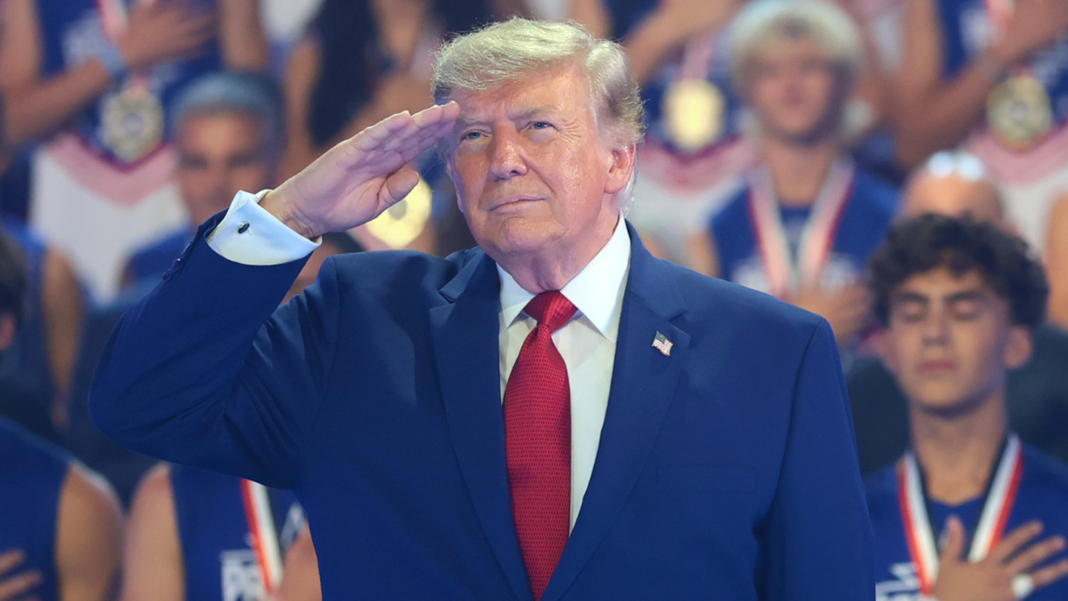
Donald Trump has found a new adviser for the White House ballroom. He has been dead since 1799. Over the weekend, Trump shared a series of apparently AI-generated images placing himself beside George Washington. In one, they wrote with quill pens. In another, they rode horses. In a short video, the two presidents strolled through the still-unbuilt ballroom while Trump thanked Washington for some of his ‘brilliant ideas’ for the project. This is where Trump’s long-running effort to manufacture legacy has arrived. History is no longer something to join. It is a guest list you can edit.
Salon reported the posts while the administration was fighting to continue work on Trump’s planned $400 million White House ballroom. A federal appeals court had ruled that aboveground construction could not proceed without congressional approval, and the administration asked the Supreme Court to intervene. Washington, for his part, never lived in the White House. He chose the site and was involved in its planning, but left office before the building was completed. John Adams became the first president to move in. None of that prevented Washington from receiving a posthumous consulting role in Trump’s feed.
The target is not AI. Presidents have always staged themselves against history. They quote predecessors, visit monuments and stand beneath portraits chosen with exquisite care. Trump simply removes the annoying part where the predecessor has to have actually said or done anything supportive. If history does not supply the endorsement, image generation can. The result is a form of presidential fan fiction with government architecture attached.
The timing makes the bit better. Trump is not merely imagining a friendly walk with Washington. He is doing it while battling over the authority to construct a massive ballroom and while pursuing other legacy projects involving his own name and image. Salon notes that the posts came amid the broader effort to shape his presidential legacy and alongside fights over the ballroom and the Kennedy Center. Trump also shared a photograph of himself in a ‘Trump 2028’ hat and declared, ‘WE ARE GOING TO WIN,’ even though the 22nd Amendment bars a person from being elected president more than twice and Trump recently acknowledged that the term-limit language is strong.
Washington is an especially funny choice for this exercise because his political mythology is built partly around leaving. He surrendered military power after the Revolution and later declined a third presidential term, helping establish the two-term tradition. Trump’s political mythology is built around staying. Staying in the spotlight, staying in the fight, staying on the building, staying in the frame. Putting the two men together in AI imagery does not resolve that contrast. It highlights it with horses.
None of this means Trump believes the fake images are documentary evidence. The posts are spectacle, and spectacle has always been central to his political language. He understands images better than most politicians understand white papers. A photo can collapse an argument into one frame. Trump with Washington says continuity, greatness, legitimacy and destiny without requiring a paragraph. The trouble is that the frame also says something else. Trump gets to decide what Washington thinks because the Washington in the picture has no vote.
That is the larger Trumpiverse pattern. Institutions, buildings and history are interesting to Trump when they can be personalized. The Kennedy Center becomes a fight over naming. The White House becomes a stage for a ballroom associated with his presidency. AI turns dead presidents into collaborators. Even constitutional term limits become material for a hat. The recurring instinct is not merely vanity. It is authorship. Trump wants to be the person who decides what the symbols mean.
There is a political advantage to that. Supporters do not have to parse a debate over permitting, congressional authority or preservation standards when the alternative is an image of Trump and Washington smiling together. Critics can protest that Washington never approved the ballroom, which is true and also slightly beside the point. The image is not trying to establish a historical fact. It is trying to make Trump look like a character in the same national story. In modern politics, vibes can outrun footnotes before breakfast.
Still, there is something revealing about needing the dead to cosign a live dispute. Washington cannot object to the ballroom, cannot question its price and cannot suggest a smaller chandelier. He is the perfect adviser. The administration can have all the prestige of consultation with none of the inconvenience of dissent.
Trump has finally discovered the cabinet model every strong-willed executive dreams of. If the president can generate historical approval on demand, what happens when the real institutions around him keep saying no?
Sources
Salon: Trump’s new ballroom adviser has been dead for 227 years
The Guardian: Trump asks US Supreme Court to allow construction of White House ballroom
Fox News: Trump brushes off reporter question about running for third term in 2028: ‘The law is very strong’