



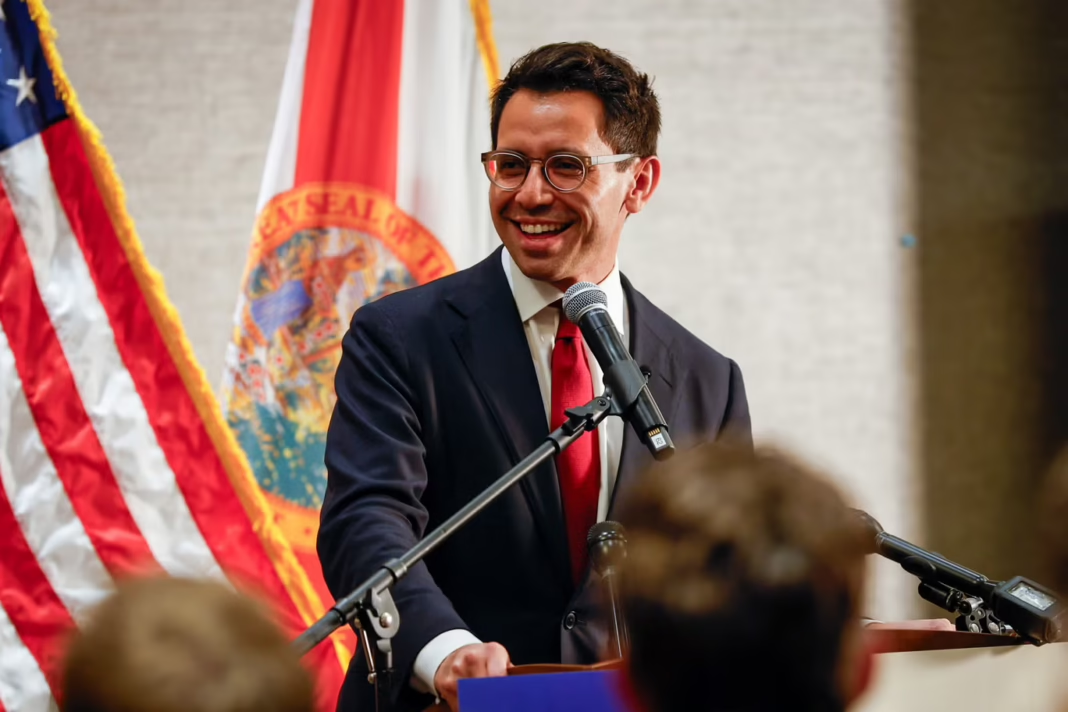
James Fishback wanted to be governor of Florida. His pollster wanted the numbers to cooperate. When those two goals collided, the voters apparently became the flexible part. The Public Sentiment Institute acknowledged that it changed some survey responses after people had selected Lt. Gov. Jay Collins, shifting them toward Fishback because Collins’s showing did not fit the firm’s read of the race. Fishback had also commissioned the poll, a sponsorship that the firm did not publicly disclose. There are many ways to produce a flattering political survey. Reassigning respondents after they answer is unusually efficient because it removes the traditional inconvenience of persuasion.
The admission surfaced after the Republican primary, which Fishback did not win. Rep. Byron Donalds took the nomination, Collins finished second and Fishback came in third. According to The Independent, polling monitor FiftyPlusOne began looking at TPSI after receiving a tip about the undisclosed campaign sponsorship. It then found the firm’s own postmortem describing how respondents who chose Collins were identified as fitting a different political coalition and were leaned toward Fishback. FiftyPlusOne called that an obvious violation of standard polling practices and said it would stop using TPSI’s surveys in its analytics. The poll did not merely miss the electorate. It tried to edit it.
Fishback’s campaign had already been built around the idea that the political establishment could not be trusted. He cast himself as an anti-establishment candidate, fought to stay on the ballot when Collins challenged his eligibility and spent the final stretch insisting the race was more competitive than conventional polling suggested. Washington Examiner coverage before the primary noted that Donalds led by wide margins while Fishback celebrated his second-place standing in some surveys. That makes the TPSI episode a particularly tidy piece of populist theater. The insurgent against manipulated institutions benefited from a poll whose own methodology included deciding that some voters had selected the wrong Republican.
The problem is larger than one failed Florida campaign. Polling already asks the public to accept a complicated chain of trust. A sample must be recruited, responses collected, demographic weights applied and uncertainty reported. Most readers never see the machinery. They see a number with a percent sign and assume the people who built it did not change a respondent’s answer because the result felt strange. Once a pollster treats its judgment as more authoritative than the answer it was hired to measure, the poll stops being a measurement. It becomes a campaign memo with decimals.
The timing makes that trust problem worse. The Independent reported that the TPSI disclosure followed another episode involving Median Strategies, a fake polling operation that published fabricated results as a social experiment. Political campaigns already spend enormous energy attacking surveys they dislike while promoting the ones they like. Fishback’s story offers the bleakest possible version of that habit. If the result is bad, call it fake. If the respondent is inconvenient, apparently there is now a vendor willing to reconsider what the respondent meant. Democracy has enough problems without introducing autocorrect for ballots that have not even been cast.
There is another reason this episode lands so hard in 2026. Fishback’s pitch was not that he was a normal candidate with a normal consultant class. He marketed himself as the person willing to say what professional politics would not. That identity depends on a sharp contrast between authentic voters and establishment manipulation. A sponsored poll that quietly helps the sponsor by reinterpreting inconvenient respondents collapses that contrast. The campaign outsider suddenly looks less like the enemy of political machinery than a customer asking the machinery for a friendlier dashboard. The populist promise is usually that ordinary people will finally be heard. It loses some sparkle when ordinary people answer a survey and the professionals decide they probably meant something else.
Political polling cannot survive if every methodological judgment is treated as sinister. Weighting is necessary because samples are imperfect, response rates vary and demographic groups do not answer surveys at identical rates. Good pollsters publish enough about their methods for experts to scrutinize the choices. That makes the TPSI account especially useful because the disputed move was not an obscure statistical adjustment. The firm’s own description, as reported by The Independent, said it identified Collins respondents whose profiles looked like another coalition and leaned them toward Fishback. The plain-language problem is devastating. A survey question is supposed to record the respondent’s choice. A model can estimate who was missed. It should not become a permission slip to replace an answer already given.
The episode also shows why sponsored polling needs more than a tiny disclosure box after the fact. Campaigns and candidates can commission surveys, but readers need to know who paid, what was changed and whether the pollster adjusted responses because reality looked inconvenient. Once a survey is presented as evidence that a candidate is surging, those choices become part of the political message. Fishback did not win the primary, but the polling fight leaves a cleaner question for the industry than for him. If a pollster can steer a result toward its own read of the race, the number on the screen is no longer measuring opinion. It is helping manufacture it.
None of this means every campaign poll is crooked or every surprising result is manufactured. Campaign-sponsored surveys are common, and legitimate pollsters disclose who paid for them and use defensible weighting methods. That distinction is exactly why this case matters. Fishback did not lose because a pollster changed answers. He lost because actual voters selected other candidates when the choice counted. The great virtue of an election is that the final dataset is much harder to massage. A candidate may dislike the electorate’s answer, but by election night there is no postmortem setting that lets the consultant lean it somewhere friendlier.
If a political poll can change what respondents said because the result does not match the pollster’s read, what exactly is left for the voters to decide?
Sources
The Independent: Second polling firm admits to fabricating data after fake survey rocks LA mayor’s race
Washington Examiner: What to know about Fishback as he tries to undermine Donalds
The Guardian: Far-right Republican accused of stiffing student debate champion of $8,000