



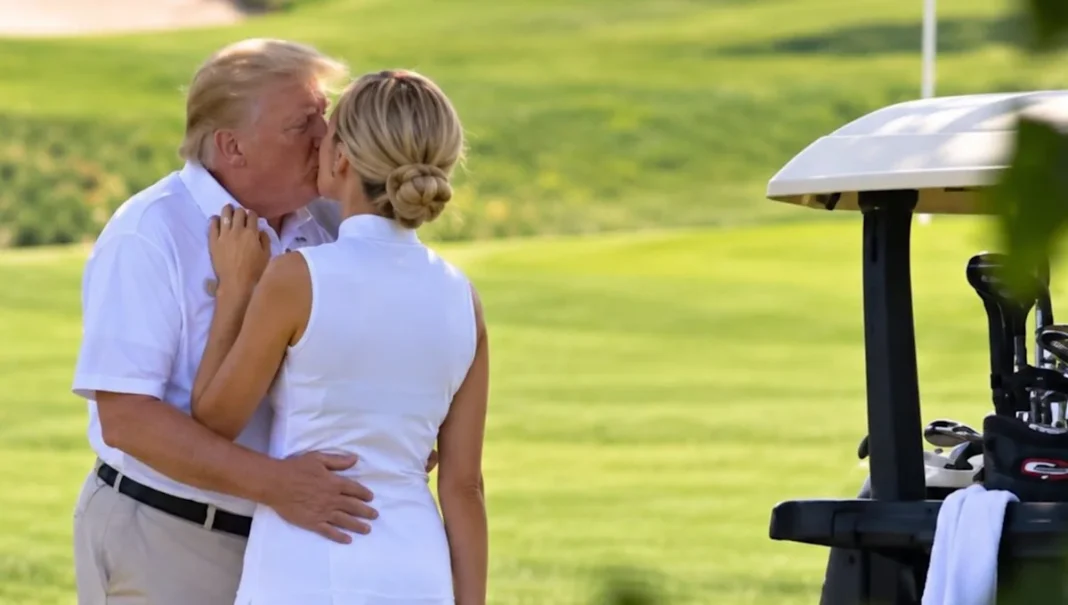
The viral image that appears to show President Donald Trump kissing aide Natalie Harp on a golf course is fake. There is no verified photograph establishing that the kiss happened, and the White House has publicly described the circulating image as fabricated.
That is the story here: not a secret golf-course kiss, but an AI-generated political image that spread widely enough online to force an official response.
Two versions of the image began circulating on social media this week, appearing to show Trump and Harp embracing on a golf course. Harp is a White House aide who works closely with Trump and has drawn public attention because of her unusually prominent role in managing material presented to the president.
The Daily Beast reported Wednesday that a White House official called the image “clearly a fake photo.”
Independent examination raised multiple reasons to doubt its authenticity before that response. Gizmodo analyzed the image and pointed to anatomical inconsistencies, including what appeared to be an extra finger on Harp’s hand in one version. The outlet also noted that ordinary AI-detection tools were inconsistent, with some automated systems incorrectly suggesting the image might be real.
That inconsistency is part of what makes the episode notable. As AI image generators improve, the old checklist of obvious mistakes – distorted hands, impossible shadows or bizarre faces – has become less reliable. At the same time, AI detectors can produce uncertain or contradictory results.
Snopes also investigated the image after it spread online and treated it as an authenticity question rather than verified photography. The image had no established original photo source that would support the claim that it documented a real event.
There were additional complications because multiple versions circulated at different resolutions. Gizmodo noted that image enhancement or upscaling can itself introduce visual artifacts, which means one strange finger is not always enough to prove how an image was created. But taken together with the lack of a verified source and the White House’s denial, the image should not be presented as evidence that Trump and Harp actually kissed.
The episode is a useful example of how political misinformation can work even when a fake is eventually debunked. A provocative image can travel much faster than the explanation of where it came from. By the time reporters or fact-checkers establish that the source cannot be verified, millions of people may already have seen the claim stripped of that context.
The visual format makes the problem harder. People tend to treat photographs as direct evidence, and a realistic image can create an immediate impression before a reader stops to ask who took it, where it first appeared or whether any legitimate news organization has authenticated it.
Trump himself has frequently shared AI-generated imagery on social media, making synthetic political visuals an increasingly common part of the broader media environment. That does not make this image authentic, and it does not establish who created it. It does show how normalized AI-generated political imagery has become.
The White House response ultimately gave the rumor another burst of attention while also providing the clearest official position: the image is fake.
For publishers and social-media users, the safer rule is simple. If a sensational political image has no traceable source, no authenticated photographer and no independent verification, it should not be presented as a real photograph simply because it looks convincing.
As AI-generated political images become harder to spot, should social platforms require clearer provenance or labeling before viral images can be treated as authentic news?