



Iranian state television broadcast footage of a staged mock hanging of President Donald Trump, according to a November 5 report by Iran International. An actor in a Trump mask and prison costume appeared in a public performance in Tehran. This was not a diplomatic communiqué, an official negotiation or even the kind of angry statement governments issue when they want the other side to read every adjective. It was political theater featuring a simulated execution. When a government wants to make its feelings known through a costume drama, subtlety has plainly left the building.
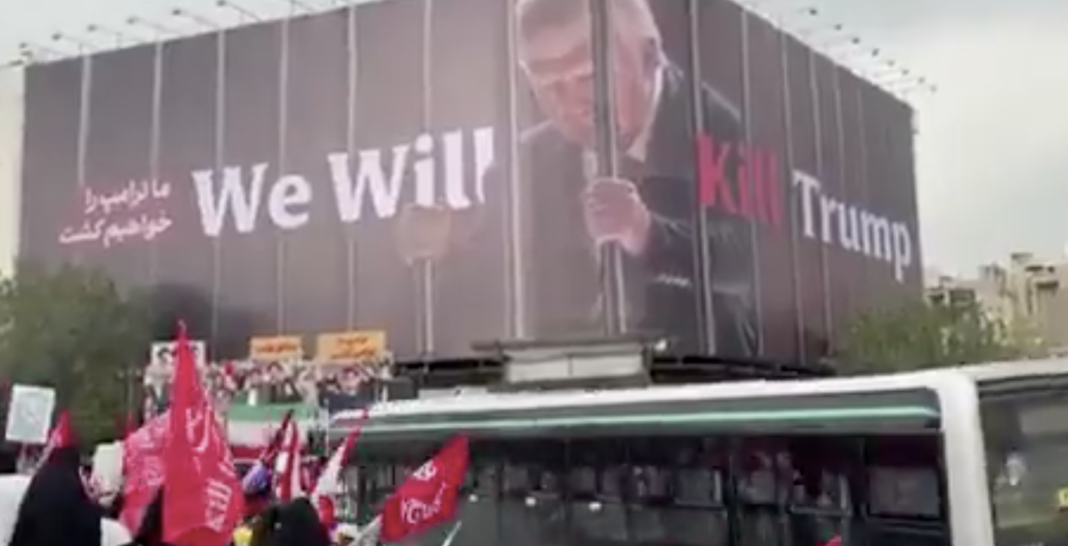
Iran International reports that the display took place in Tajrish Square and was part of a broader campaign of anti-American demonstrations around Tehran. The outlet also describes a large banner depicting Trump, Vice President JD Vance, Israeli Prime Minister Benjamin Netanyahu and U.S. envoy Steve Witkoff being burned in Enghelab Square. A separate billboard carried a threat against Trump. Those details are reported by Iran International; independent confirmation from a second approved BuzzyTimes outlet was not available during preparation. They therefore belong in the article as attributed reporting, not as independently established facts.
The events were linked to commemorations of the 1979 seizure of the U.S. Embassy in Tehran and followed the November 3 American midterm elections. Iran International says Iranian official and diplomatic accounts circulated additional mocking images, including an AI-generated video portraying Trump being removed from the White House. That combination is revealing. A government that has serious disagreements with Washington chose to package its message as a mixture of public spectacle, historical grievance and digital ridicule. International relations have enough real dangers without the addition of a theatrical department, but apparently the department has a budget.
There is nothing lighthearted about public calls for violence against a political leader. The target of scrutiny here is the decision to use threatening spectacle as a state-linked communication tool. Political leaders are routinely caricatured, criticized and mocked. A staged execution crosses into a different register. It may rally an audience already inclined to agree, but it is difficult to see how it makes the underlying dispute easier to resolve. It tells viewers how angry the organizers are while offering almost no information about what they want the other side to do next.
The context makes the performance more than a strange video. Iran and the United States are dealing with the consequences of military conflict and the prospect of further confrontation. Iran International reports that Trump attributed part of the Republicans’ midterm setbacks to the war and associated price increases while continuing to defend the campaign. Those are consequential questions about war, diplomacy and domestic costs. A mannequin-like performance in a square cannot answer any of them. It can, however, dominate a news cycle, which is presumably part of the attraction.
Political theater is old. Broadcasting it to the world and adding AI imagery makes it easier to distribute and harder to ignore. The risk is that spectacle becomes a substitute for a position, and each side responds to the image rather than the issue underneath. Iran’s leaders have every opportunity to state their demands plainly. The decision to stage a threatening scene instead raises the stakes of public rhetoric without creating an obvious path to a deal. The world does not need another production company with access to foreign policy.
Will Tehran’s public threats make any diplomatic outcome more likely, or simply make the next round of confrontation harder to contain?