



Federal prosecutors say a Nevada man made online threats against Trump and a mass shooting. Police seized 15 firearms from his home and vehicle.
A federal death-threat case involving President Donald Trump already sounds alarming. Add 15 seized firearms, ammunition, and alleged online references to a mass shooting, and the story gets considerably more serious. Prosecutors say a Nevada man posted threats directed at Trump and others; investigators moved in on October 16. The suspect now faces a federal indictment, while authorities stress that the charges remain allegations.
The man is Jason Randall Utlaut, a resident of Henderson, Nevada, near Las Vegas. The Justice Department announced on November 5 that a federal grand jury had charged him with one count of threatening the president. That is a very specific charge, and it matters: this is not an announced assassination-attempt prosecution, a mass-shooting case, or a finding that he committed violence. The alleged messages, however, were serious enough to trigger a same-day law enforcement response.
It is an unsettling combination of digital threats and a substantial cache of weapons. The internet has a remarkable talent for making outrageous statements feel routine, as if a threatening comment is merely another opinion wedged between cat videos. Federal investigators, understandably, do not have the luxury of treating every alleged death threat as performance art. Their job is to determine whether it represents a real public-safety danger.
Five Posts Trigger an Emergency Alert
According to the U.S. Attorney’s Office for the District of Nevada, the FBI National Threat Operations Section received an emergency notification on October 16 about five posts uploaded to a YouTube channel. Authorities said the messages included threats to kill the president, threats of a mass shooting, and other violent statements. Investigators subsequently attributed the posts to Utlaut. The indictment followed about three weeks after the alert.
The Las Vegas Sun reported that one of the alleged posts referenced stockpiling weapons and ammunition and threatened Trump along with his supporters. Those are claims prosecutors must prove, not evidence that any threatened attack was actually underway. Public reporting has not established a specific attack site, a timetable, or that an attempt to approach the president occurred. That distinction is not a technicality; it is the difference between the conduct alleged and a crime nobody has charged.
The platform involved also helps explain why the case drew federal attention. The government says investigators were responding to material that appeared online, rather than to a suspect found at a presidential event. Threat-assessment work often begins with a message, a tip, or a pattern that seems too dangerous to ignore. A YouTube comment section is not normally where anyone expects to encounter a presidential-security case, but the medium does not make the language harmless.
Fifteen Firearms Seized in Henderson
The same day the FBI received the alert, Las Vegas Metropolitan Police Department officers executed a search warrant at Utlaut’s home and vehicle in Henderson, according to the Justice Department. They seized 15 firearms, multiple firearm magazines, and ammunition. Officials have not publicly specified in the announcement which types of firearms were recovered or whether any were unlawfully possessed. Fifteen is the confirmed count; everything else about the weapons should not be filled in with imagination.
For investigators, that discovery was obviously relevant to assessing the alleged threats. But possessing firearms, even numerous firearms, does not by itself establish that someone planned to shoot a president. Nor does the seizure amount to proof of a completed murder plot. The weapons are a key fact in the prosecution’s account because of their proximity to the alleged violent messages, not because the government has announced a separate gun-trafficking charge in this case.
Local outlet FOX5 Las Vegas confirmed the timeline and the weapons seizure in its November 5 report. The Las Vegas Review-Journal identified Utlaut as 57, while Courthouse News reported that jail records placed him in custody the day after the October search. Those details provide a clearer chronology than the breathless social-media versions that can turn an indictment into an imaginary shootout. There is plenty to examine here without giving the case a Hollywood ending it did not have.
The Charge and the Next Court Date
Utlaut is charged with one federal count of making a threat against the president. If convicted, the maximum statutory penalty is five years in prison, the Justice Department said. His arraignment is scheduled for November 18 before U.S. Magistrate Judge Maximiliano D. Couvillier III. The indictment is an accusation, not a verdict, and Utlaut is presumed innocent unless proven guilty.
The case was investigated by the FBI, Las Vegas Metropolitan Police Department, and Henderson Police Department. Assistant U.S. Attorney Dan Cowhig is prosecuting it. That division of labor is not surprising: the alleged target was the president, but the police work involved a Nevada residence and vehicle. Federal and local agencies therefore had overlapping reasons to take the messages seriously.
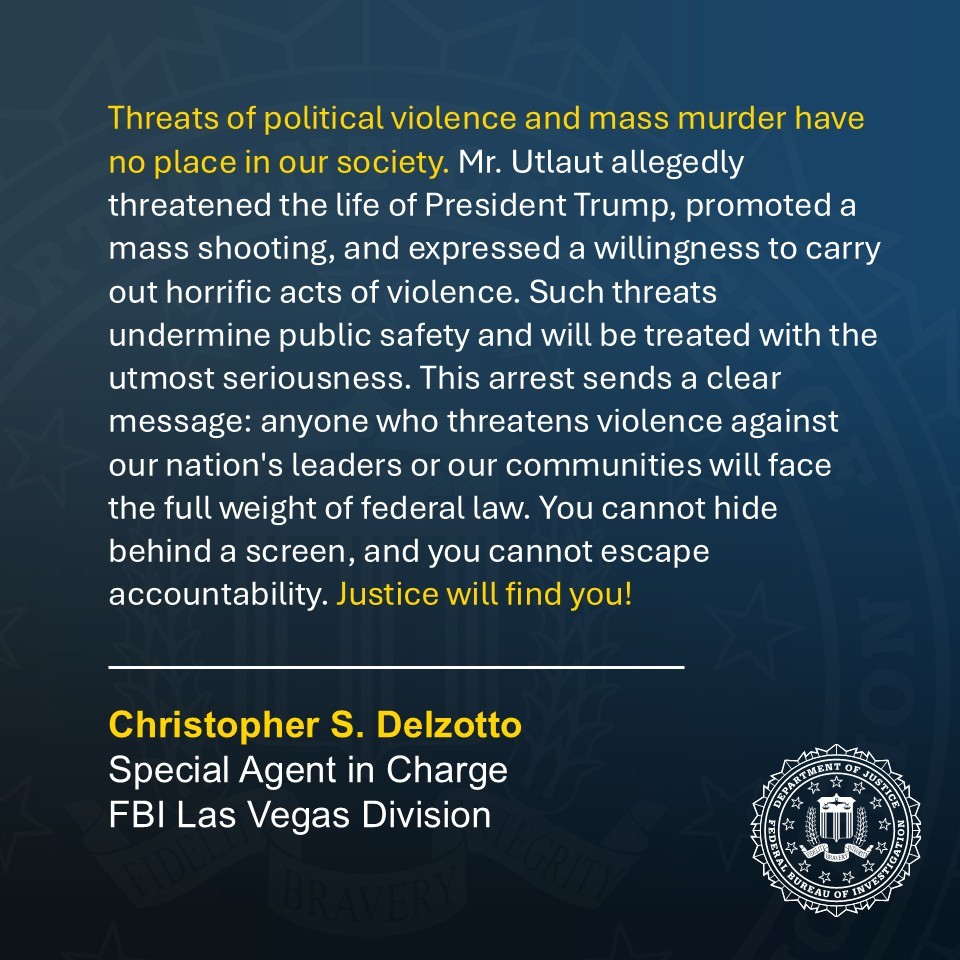
FBI Las Vegas Special Agent in Charge Christopher Delzotto denounced threats of political violence and mass killing in the department’s announcement. First Assistant U.S. Attorney Sigal Chattah also issued a forceful warning to anyone threatening the president. Those statements reflect the government’s position on the case; neither should be mistaken for a court finding about Utlaut’s guilt. Prosecutors get a microphone at the announcement, but the courtroom still gets the final say.
Why This Case Is Different From the White House Arrest
This Nevada indictment is separate from the recently reported arrest involving an armed man near the White House and alleged threats against Trump. The two stories share a frightening theme, but they are not the same suspect, location, or investigation. Combining them into one giant presidential assassination narrative would be dramatic, and also wrong. Political news does not need a cinematic universe.
What links them is the problem facing presidential security: authorities must respond to threatening behavior before an attack happens, while being careful not to declare that every alarming message amounts to an actual attempt. Online speech, physical weapons, and evidence of intent can raise very different legal questions. In this case, prosecutors have chosen the charge that corresponds to the threats they say they found. That limited charge should shape the headline and the reporting.
The case also illustrates how little certainty can be gleaned from a viral summary. The court has not yet weighed the evidence in open proceedings, no jury has rendered a verdict, and an alleged post is not a confession just because prosecutors quote it. It is reasonable to be alarmed by the combination described in the public record. It is not reasonable to invent a completed plot or a dramatic arrest scene to make the facts feel even bigger.
So here is the situation without the internet’s usual embellishments: five alleged threatening posts, a fast law enforcement response, 15 seized firearms, one federal charge, and a November 18 court date. That is a serious enough story on its own. In a country where political language can go from angry to threatening in a few keystrokes, the most important question is what prosecutors can actually prove.