



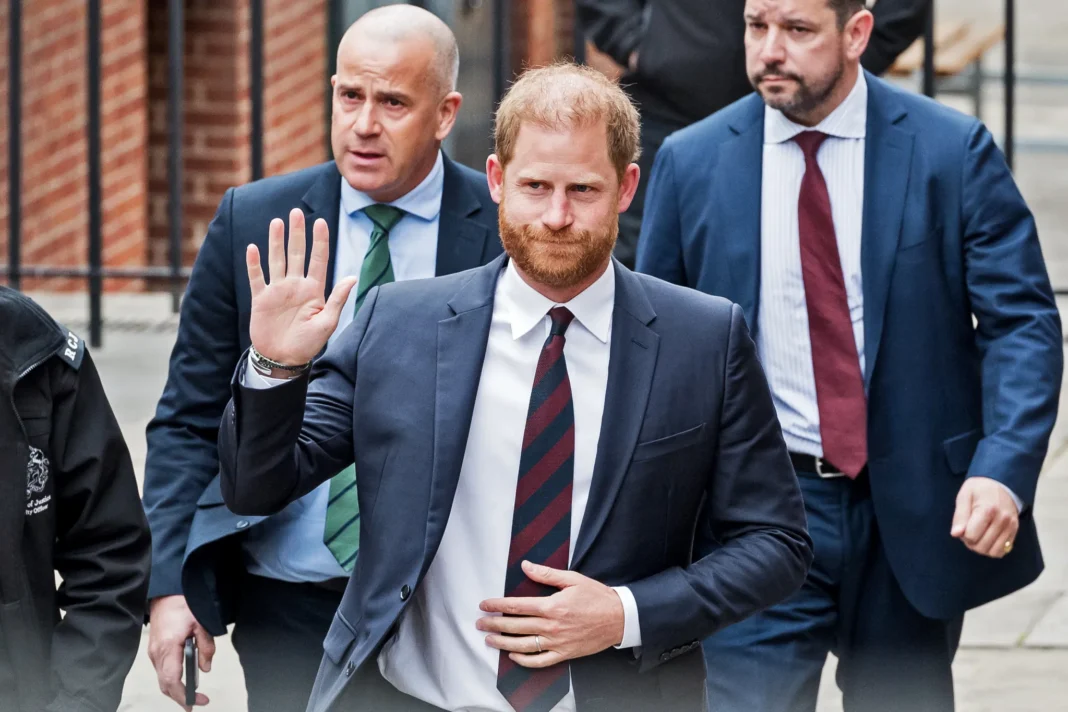
Prince Harry is preparing to spend more time in Britain, which is convenient because Britain has just sent him a bill. On Friday, the High Court ordered Harry and six co-claimants to make a £9.54 million interim payment toward Associated Newspapers Ltd.’s legal costs after they lost their case against the publisher of the Daily Mail. The payment is due by 4 p.m. on Aug. 28. The court has been told ANL’s total costs exceed £34 million. Nothing says welcome home quite like a seven-day deadline and eight figures on the invoice.
The ruling is the latest consequence of a case Harry pursued with Doreen Lawrence, Elton John, David Furnish, Sadie Frost, Elizabeth Hurley and Simon Hughes. They accused Associated Newspapers of unlawful information gathering. The publisher denied the allegations. Last month, Mr Justice Nicklin dismissed all of the claims after an 11-week trial, finding the claimants had not proved that the information at issue had been obtained unlawfully. On Friday, the judge ordered the interim costs payment while the final bill is still being worked out. The court did not find that any claimant acted dishonestly, an important distinction in a case where the losing side is now staring at a legal tab that could buy several very nice houses outside London.
Harry’s timing gives the judgment an extra layer of royal comedy. This week, reports said he and Meghan plan to return to Britain with Archie and Lilibet for an extended period, with the children expected to begin school in the UK. The move is being treated as a major reset after six years in California. Harry has also talked publicly about reconciliation with his father and appears to have made some progress there. Yet the country he is returning to remains the same country where he has spent years fighting newspapers, challenging security decisions and describing the press environment as dangerous to his family. The welcome mat is out. So is the costs order.
The target here is not Harry for using the courts. Public figures have every right to sue when they believe a newspaper has crossed a legal line, and Harry has previously won or settled other media cases. The absurdity is the size and persistence of the campaign after this particular case failed so comprehensively. The July judgment rejected all 97 allegations advanced in the lawsuit. Associated Newspapers called that result a vindication of its journalism and said it would pursue costs. Harry called the judgment a whitewash. Both sides remain exactly as committed to their positions as they were before an 11-week trial, which is one reason lawyers tend to enjoy long-running principles more than clients do.
The Guardian reported in July that Harry had taken steps to protect Doreen Lawrence from being left personally out of pocket, and insurance had been arranged to cover part of the claimants’ exposure. That matters because Friday’s £9.54 million order is an interim payment shared across the group, not a £9.54 million personal invoice addressed solely to the Duke of Sussex. Still, Harry is one of the central figures in the litigation, and the financial consequences are now impossible to separate from the larger story of his British return. He left the royal system in part to gain control over his life and his relationship with the media. Six years later, the media relationship has produced another court battle, another defeat and another reason for everyone to calculate who pays for what.
That calculation is already following him into the next chapter. Security remains unsettled. Harry lost a separate legal challenge over taxpayer-funded protection after stepping back as a working royal. His family’s return raises fresh questions about how protection will work when they are living in Britain more regularly, especially because private security cannot simply replicate every power available to police. The Sun has reported fears that long-term arrangements could become extremely expensive, while the government has described the matter as private. Add a major legal-cost order to that unresolved security question and Harry’s return starts looking less like a simple family homecoming than a complicated spreadsheet with a royal crest in the corner.
There is a broader thread too. Harry’s campaign against the British press has been one of the most consistent causes of his post-royal life. He has often framed it as something larger than himself, tied to his mother’s experience and his belief that powerful newspapers have escaped accountability. That makes the latest defeat more consequential than a bad day in court. If the legal strategy keeps producing enormous costs without changing the institutions he is fighting, he has to decide whether persistence still serves the mission or merely proves how expensive the mission can become. Conviction is admirable. So is knowing when a tactic has stopped working.
For the tabloids, of course, the whole thing is irresistible. The prince who says the British press helped drive him out is coming back to Britain just as the publisher he accused of wrongdoing is collecting millions in costs from the failed case. Nobody needed to invent a punchline. The docket did it. Harry can still appeal aspects of the judgment and costs rulings, and the final financial exposure has not been settled. But the direction is plain enough for now. Reverse Megxit has barely begun, and one of Harry’s oldest British battles has already followed him through the door. The practical question is no longer whether the case mattered to him. It plainly did. The question is what another round can still achieve.
If Harry is coming back to build a more settled life in Britain, how much longer can his war with the British press remain one of the main things defining it?
Sources
The Guardian: Prince Harry and others ordered to pay interim £9.5m to Daily Mail publisher
The Sun: Prince Harry & celeb pals hit with first court bill of £9.5m after failed hacking case – ahead of return to UK
The Sun: Just WHO will pay for Meghan & Harry’s security? Fears grow UK return could cost taxpayer £5million-a-year