




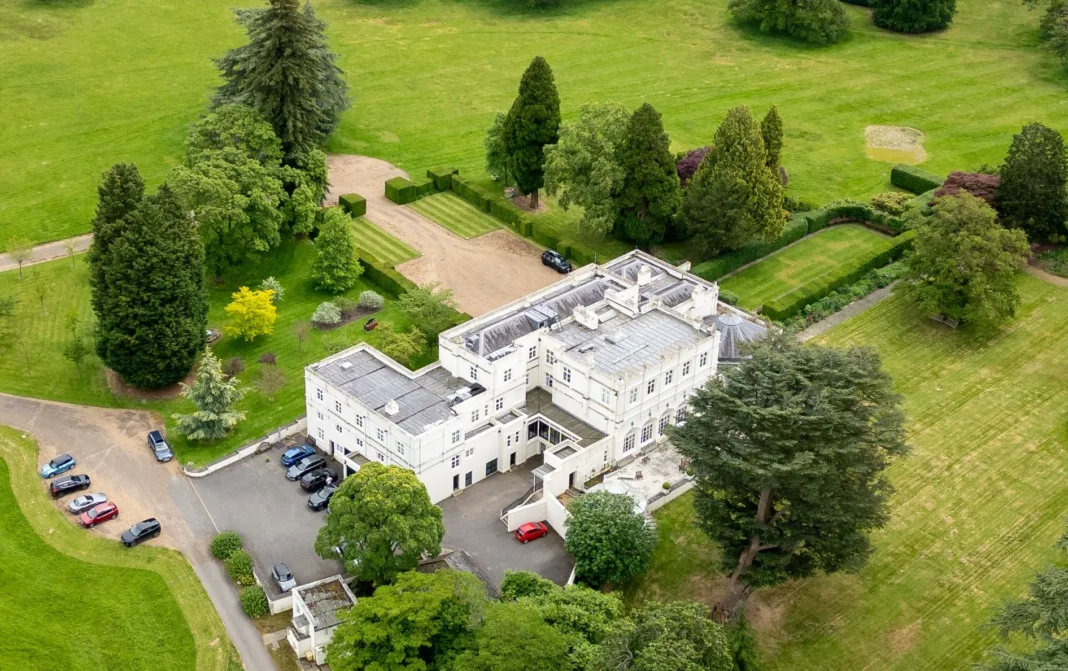
Royal Lodge has spent years as Britain’s most elaborate argument over whether a mansion can be both priceless and somehow almost rent-free. Now the 31-room Windsor property may be about to encounter a concept familiar to people who do not have royal leases. Market rent. The Sun reported Monday that Andrew Mountbatten-Windsor’s former home is expected to return to the commercial rental market after his surrendered lease fully clears in October, with a potential annual rent of about £1 million. There will be strict security requirements, heavy maintenance costs and no shortage of palace-level complications. Still, after two decades of peppercorn rent and explanations that required paragraphs, the Crown Estate may finally answer the simplest question in property. What would somebody actually pay to live there?
The old arrangement was not technically free, which is an important distinction and also exactly why this story has needed so many footnotes. Andrew paid a £1 million premium when he took the 75-year lease in 2003 and was required to fund at least £7.5 million in refurbishment. The Independent reported in July that the lease then required only one peppercorn in annual rent if demanded. The Guardian previously described the same structure and noted the Crown Estate’s argument that Royal Lodge’s sensitive location and security needs made an ordinary open-market tenancy unrealistic. In other words, the house had a market value, but the market itself was apparently too common to be invited in.
Then the arrangement became even harder to explain. A National Audit Office investigation disclosed that Andrew received private income from subletting three cottages on the estate while paying the nominal rent on the main lease. The Crown Estate told MPs that the subletting rights and refurbishment spending had been considered when the original deal was judged to offer value for money. That is a legitimate accounting position. It is also a sentence with the rare ability to make the phrase ‘one peppercorn’ sound aggressive. The public had spent years hearing that Royal Lodge was too unusual for normal rental comparisons, only to learn that parts of the estate were normal enough to produce private rental income.
The target here is not royal housing itself. Monarchies have residences. Security changes what those properties can be used for. Historic estates are expensive to maintain. The target is the institutional habit of allowing a favorable arrangement to become so complicated that complexity starts functioning as its own defense. Every question about Royal Lodge produced another layer. There was the premium, then the refurbishment, then the peppercorn, then security, then maintenance, then subletting. By the time anyone reached the bottom, the answer to ‘what does this cost?’ had become a small postgraduate course in Crown Estate tenancy law.
A commercial lease could puncture that fog in one very useful way. If Royal Lodge really can command something close to £1 million a year, the public gets a visible benchmark for the privilege of occupying it. If it cannot, that tells us something too. The number will not erase the special costs attached to a heavily protected historic property, but it will do what years of palace explanations could not. It will put an ordinary unit of measurement next to an extraordinary arrangement. Pounds per year. No peppercorn required.
The market test may also expose why the old defense was only partly satisfying. The Sun reported that a future tenant would face stringent security checks and could be responsible for annual maintenance costs estimated around £400,000. That shrinks the pool of plausible renters considerably. Fine. Let it. A genuine market does not promise a flattering answer. It reveals the price after the inconveniences are included. If wealthy tenants decide that £1 million plus upkeep is too much for the honor of living behind the gates, the Crown Estate will learn that. If somebody happily pays it, taxpayers will finally have a comparison that does not require knowing what a peppercorn meant in 2003.
Royal Lodge became politically toxic because the grandeur was visible and the economics were not. People could see the gates, the acreage and the scale of the building. They could not easily see the full value of the arrangement, especially once private funding, royal support, maintenance obligations and bespoke lease terms were mixed together. That is the wider thread. Institutions often defend unusual privileges by pointing out, correctly, that the situation is unusual. The problem begins when ‘unusual’ becomes a permanent exemption from basic comparison. Royal Lodge may be special. It is still a property. Someone can put a price on it.
There is something almost therapeutic about the next phase. The house does not need another round of constitutional soul-searching. It needs a tenant who can clear security, afford the upkeep and sign a lease. After years in which Royal Lodge became a symbol of how slowly the royal machine can confront an awkward arrangement, the solution may turn out to be the least glamorous one available. List the place and see what happens. The monarchy will survive the indignity of discovering what Zoopla would have wanted to know on day one. It may even benefit from the clarity. A transparent commercial lease would not solve every question about royal housing, but it would make this particular house much harder to hide behind custom, precedent and bespoke arithmetic. Sometimes modernization is just sending an invoice.
If Royal Lodge can now be priced like an asset, why did it take years of scandal to make its value this easy to see?
Sources
The Sun: Andrew’s 31-room Royal Lodge mansion up for grabs after he was forced out by King – but with VERY strict rules
The Independent: Andrew’s Royal Lodge lease and subletting offered ‘value for money’, MPs told
The Guardian: Does Prince Andrew live rent-free at Royal Lodge and can he be evicted?