



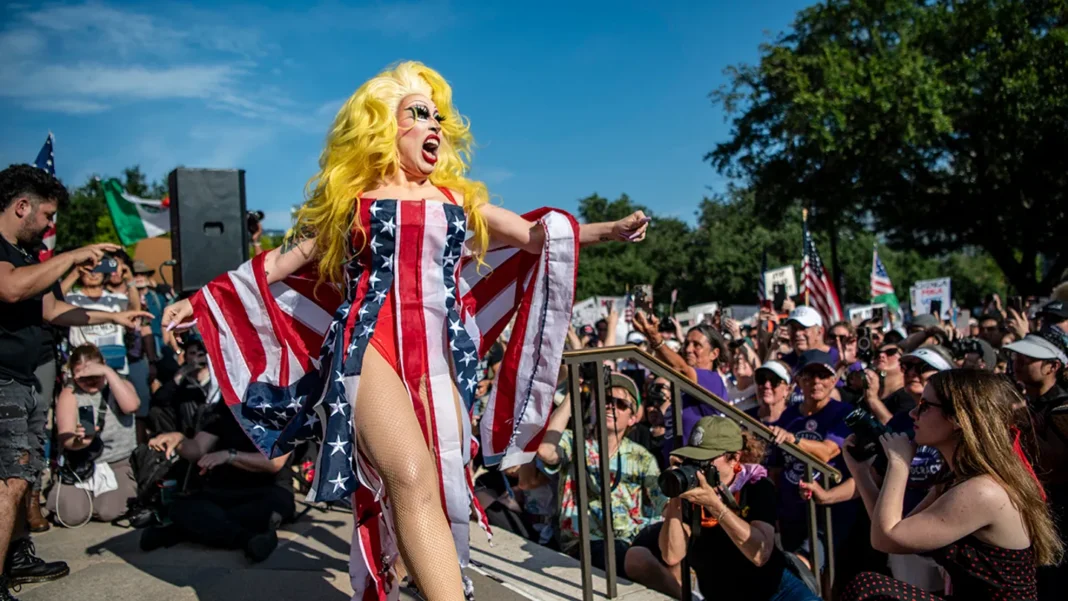
Texas tried to write a law aimed at sexually oriented performances in front of minors. A federal judge has now ruled, again, that the state wrote something much bigger. On Wednesday, Breitbart carried a UPI report that U.S. district judge David Hittner permanently blocked Senate Bill 12 as an unconstitutional restriction on speech. The underlying ruling said the law’s reach was so broad that protected performances could be swept into it. Other reporting on the decision noted examples ranging from cosplay and swimming to Dolly Parton and Elvis impersonators. Texas set out to regulate drag and somehow drafted a legal net with room for rhinestones, sideburns and the backstroke.
The law dates to 2023, when Governor Greg Abbott signed SB 12. It imposed civil penalties on businesses hosting covered performances and criminal penalties on performers. Hittner struck it down that year, and the litigation kept going. After an appeals court sent the case back for another look, Hittner reached the same basic conclusion. The state has now spent years proving that culture-war legislation can have a longer theatrical run than most Broadway shows, especially when the script keeps returning to the same judge.
The Too Red target is not Texans who dislike drag shows. People are allowed to dislike things. Hittner’s ruling made that point with unusual efficiency. For people offended by the performances at issue, he wrote, the solution is “relatively simple … just don’t go.” The target is the Republican habit of taking a cultural preference and trying to convert it into a statewide speech code. There is a large constitutional distance between “I would not take my child to this” and “the government should decide which costumes and gestures can trigger criminal penalties.” Texas tried to cross it in cowboy boots.
Attorney General Ken Paxton called the ruling “flawed” and said he would appeal. That means the state is not done defending the law. But the problem identified by the court is not a technical typo that can be fixed with a better comma. The judge concluded that the vast majority of the law’s applications burden constitutionally protected expression and target performances based on content and viewpoint. When your child-protection law needs courts to determine whether an impersonator, actor or convention attendee has crossed an expressive line, perhaps the drafting meeting wandered away from child protection.
There is a real policy question here. States can regulate obscenity, public nudity and conduct involving minors within constitutional limits. Venues can set age restrictions. Parents can decide what their children attend. None of that requires pretending every drag performance is the same thing or writing definitions so loose that unrelated performances can get caught. The political appeal of a broad law is obvious because it lets lawmakers announce a sweeping victory. The legal weakness is the same thing. Sweeping is what courts notice.
The case also shows how culture-war politics rewards legislation before anyone asks whether the law will survive contact with the Constitution. The signing ceremony happens immediately. The fundraising email follows. The television hit arrives before dinner. The litigation takes years. By the time a judge says the measure was too broad, the politicians who sold it have already collected the political benefit of having “done something.” Taxpayers get the appellate briefing schedule.
Paxton’s promised appeal will keep the argument alive, which may be part of the attraction. A final, narrow and workable rule would be less useful politically than a permanent fight between Texas and federal judges. Every loss can become proof that courts are hostile to conservative values. Every appeal can become another campaign message. The actual constitutional question gets buried under the much more marketable claim that somebody somewhere is refusing to protect children.
That is why Hittner’s blunt suggestion lands so hard. “Just don’t go” is not a complete theory of public regulation, but it is a useful reminder that a free society often requires tolerating expression you would never buy a ticket to see. Texas wanted a law that drew a bright moral line. It produced years of litigation over where the legal line actually is. The state can appeal again. It can rewrite the statute. What it cannot do is make the First Amendment disappear because a costume makes legislators uncomfortable.
How many years of litigation does a culture-war law need before lawmakers admit that “we dislike this” is not the same thing as “we can ban this”?
Sources
Breitbart: District court judge rules Texas’ drag show ban unconstitutional
Fox News: 5th Circuit clears Texas to enforce drag show law in front of minors, Paxton claims ‘major win’