




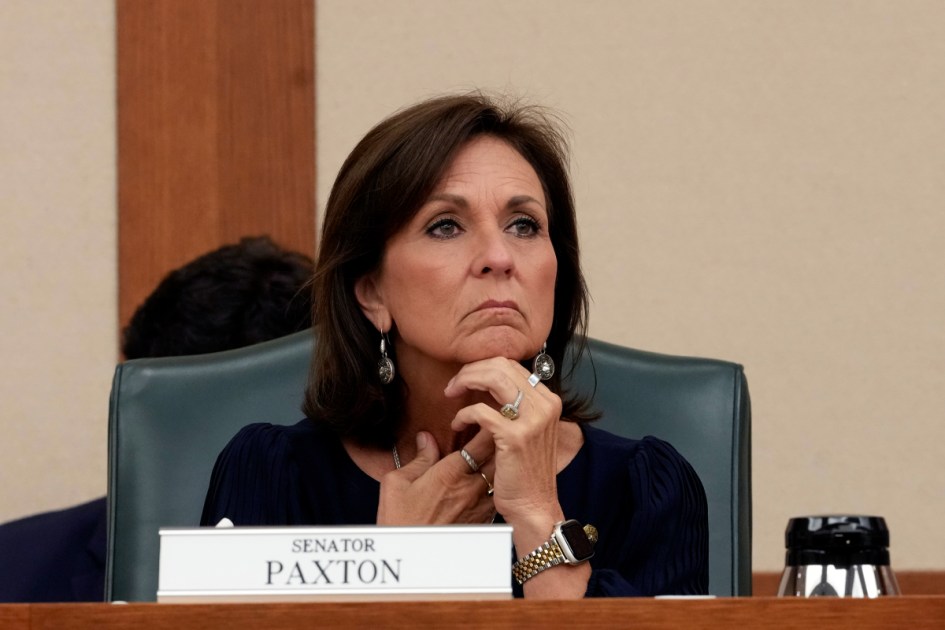
Angela Paxton never said her estranged husband’s name. She did tell Republican women that when they’re angry at a candidate, the seat may matter more than the person.
There are political speeches about unity. There are political speeches about principle. And then there is the speech where a woman who filed for divorce from her husband on grounds that included adultery stands in front of Republican women and essentially tells them: yes, you may be furious with the person on the ballot — vote for the party anyway.
That is the strange position Texas state Sen. Angela Paxton found herself in this month as her estranged husband, Republican Senate nominee Ken Paxton, campaigns for one of the most closely watched seats in the country.
At a ticketed meeting of the Texas Federation of Republican Women in Round Rock, Angela Paxton delivered a speech titled “The Elephant in the Room.” She did not say Ken Paxton’s name. She did not explicitly endorse him by name. But she did tell the room that Republican voters should think beyond the individual candidate.
“It’s not the people — it’s the seat,” Paxton said, according to video of the remarks reported by The Texas Tribune. Her argument was that control of the seat gives the party influence over the future, even when voters are “mad” at the person carrying the party label.
That would be a fairly conventional party-unity argument if the person making it were just another Republican state senator. Angela Paxton is not just another Republican state senator.
She filed for divorce from Ken Paxton in 2025 on what she called “biblical grounds.” Her original divorce petition cited adultery. The couple’s marriage had already been dragged into public view during Ken Paxton’s 2023 impeachment trial, when testimony included allegations about an extramarital affair. Ken Paxton was acquitted by the Texas Senate on all impeachment charges.
Now he is the Republican nominee for U.S. Senate, and Angela Paxton is asking Republican women to separate their feelings about individual candidates from control of the office itself.
One attendee told the Tribune that Angela Paxton acknowledged what she called a “moral dilemma.” Another attendee said the message was blunt: if voters cannot bring themselves to vote for a candidate, they should at least understand what voting for the other party means for control of the seat.
That is what makes the moment so politically unusual. Party leaders ask voters to look past candidate flaws all the time. Spouses usually are not the ones making the pitch after filing for divorce over alleged infidelity.
Angela Paxton also reportedly emphasized that party affiliation has consequences after Election Day. Members who break with their caucus can face pressure, committee consequences or political retaliation. In other words, she argued that the party attached to the candidate does not disappear once the campaign signs come down.
Her remarks come as Republicans are trying to hold a Texas Senate seat that, in most election cycles, would not require this much drama. Ken Paxton won the Republican nomination after defeating incumbent Sen. John Cornyn in the primary. The general-election race has drawn national attention as Democrats try to make Texas unusually competitive.
The speech therefore had two audiences. One was the room: Republican women who may have serious personal objections to the nominee. The other was everyone outside it, because once video of “The Elephant in the Room” escaped the room, the elephant got significantly larger.
To be clear, Angela Paxton did not publicly tell the women, “Vote for Ken.” She reportedly avoided saying his name at all. That distinction matters. But her broader instruction — vote for the Republican seat even if you are angry at the Republican candidate — lands differently when the candidate is the man she is divorcing.
It is also a tidy example of a tension both parties face every election cycle: are voters choosing a person, or are they choosing control of an institution?
Campaigns love to insist the answer is both. Candidates sell their character, biography and judgment, then party leaders remind voters that committee chairs, judicial confirmations, investigations, budgets and legislation depend on which letter sits next to the winner’s name.
Angela Paxton’s speech stripped away most of the usual packaging and made that tradeoff unusually explicit.
She told Republican women they may be mad at the person. She told them the seat still matters. She did it without naming the Republican nominee. And everyone in the room appears to have understood exactly who the unnamed candidate was.
That is about as close as modern politics gets to saying the quiet part with a microphone.
The question now is whether voters see party control the same way. If you believe a candidate has personally failed a moral test, should the party label still outweigh the person wearing it?