



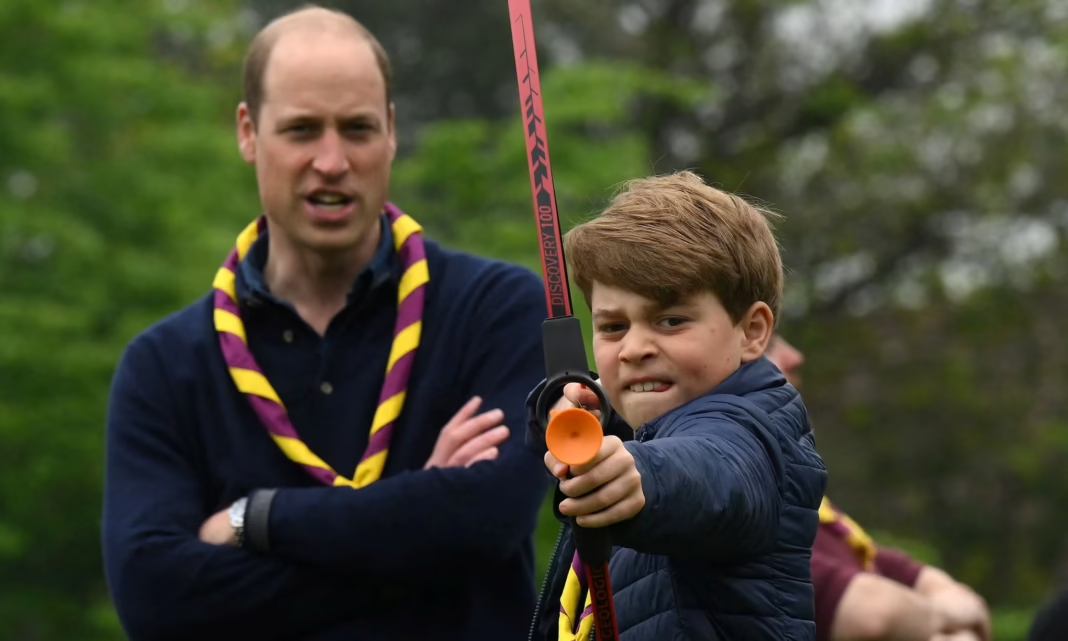
Prince George began at Eton this week, which means Britain’s future king has entered the one school in the country where becoming an F-blocker is an upgrade. The 13-year-old arrived with William and Catherine, shook hands with the headmaster and disappeared into a 586-year-old institution that charges about £65,000 a year to teach boys Latin, cricket and a private dialect apparently assembled during several centuries when nobody thought plain English was sufficiently exclusive. The monarchy has spent years promising to look more modern. Naturally, the heir has now enrolled somewhere that calls teachers beaks.
The Sun’s account of Eton life reads less like a school guide than an orientation packet for a small constitutional principality. New boys are F-blockers. Older pupils may serve as uncles or timelords. Terms are halfs. Teachers are beaks. Rowers are Wet Bobs, athletes can be Dry Bobs and boys who do neither may be Slack Bobs. This is what happens when an institution has existed since 1440 and nobody has had the authority to ask whether the glossary could perhaps be cut to one page. George is second in line to the throne, yet for the next few years even he must learn that the ordinary word for something is usually the wrong answer.
There is nothing inherently sinister about a school having traditions. Every institution develops rituals, slang and alumni stories that become more charming the longer nobody explains them to an outsider. Eton simply has the advantage of having accumulated nearly six centuries of material and enough famous former pupils to make nostalgia part of the curriculum. It has educated Prince William, Prince Harry and 20 British prime ministers. That record either demonstrates extraordinary preparation for leadership or proves that Britain has been running the same group project for a very long time.
The funny part is the collision between the Waleses’ public mission and the place they have chosen for George. William and Catherine have worked hard to present themselves as a relatively normal family. They talk about school runs, limited screen time and giving their children room to grow before royal duty takes over. Eton offers George a basic phone instead of a smartphone, which certainly helps with the screen-time goal. It also offers 19 cricket pitches, three theaters, a rowing lake used for the 2012 Olympics and, for older pupils, access to a school pub. Most parents manage digital restraint with a kitchen drawer. The future king gets a 1,600-acre campus.
The decision is not new and the family did not choose the school in secret. Kensington Palace confirmed months ago that George would follow his father to Eton. Catherine was previously reported to have reservations about single-sex boarding schools, while William has spoken warmly about his own time there. Those differences are normal parental questions. What makes them royal is that a school decision becomes a national argument about continuity, privilege and what sort of childhood Britain should build for someone whose adult job already comes with palaces.
Eton is also almost perfectly designed to expose the monarchy’s modernization paradox. Royals are expected to be relatable enough to justify their place in contemporary Britain and exceptional enough to justify the entire institution. George should have friends, homework and a brick phone like a normal teenager. He should also attend a school where the fees exceed many British household incomes and where the vocabulary can make a new student sound as though he has joined a minor order of medieval administrators. The monarchy wants normality with better tailoring. Eton provides exactly that, provided your definition of normal includes a timelord.
None of this is George’s choice to defend. He is a child entering the school his parents selected, and turning him into the joke would be both cheap and contrary to the facts. The target is the system around him. Britain has spent decades debating whether inherited power can be made to feel less inherited. One answer, apparently, is to send the heir to the same elite institution his father attended and explain that this is a personal educational decision. It is personal. It is also what dynasties call Tuesday.
Eton’s defenders can point to academic standards, pastoral care, scholarships and generations of graduates who loved the place. They are entitled to. The question is not whether Eton can educate a bright teenager. The question is what the choice symbolizes when the teenager is being prepared, however gently, for a constitutional role nobody else in his class can apply for. A monarchy cannot choose its heir. It can choose the surroundings in which that heir learns what leadership looks like.
William has said he enjoyed being able to move around Eton as just another student. George may value the same thing, and genuine privacy during adolescence would be a gift to any child growing up under cameras. But even that normality depends on extraordinary machinery. Police protection remains nearby. The press follows his arrival. Official portraits mark the milestone. The boy gets to be ordinary inside one of Britain’s most exclusive institutions because an enormous public system is working very hard to make ordinary possible.
That may be the best available arrangement for a family whose children cannot simply disappear into a local secondary school and hope nobody notices. It may even be a happy one. But the image is hard to improve upon. A future king has started school at a place with beaks, Bobs, timelords, private rooms and a fee that would make many parents need a second mortgage. The palace keeps saying the monarchy is evolving. Eton has kindly supplied the vocabulary to ask whether evolution can include going back to the same school again.
If the monarchy wants the future king to grow up more normally, why does normality still look so much like inherited privilege?
Sources
The Sun: George, 13, looks just like Wills in new uniform on first day at Eton after proud mum & dad drop him off
The Sun: What life will be like for George at £65k-a-year Eton…from meeting ‘timelord’ to ‘rip’ rule & truth behind boozing at 16
The Guardian: Kate doesn’t want Prince George to go to Eton – and for once I agree with her