



The British monarchy has spent six years insisting that Prince Harry and Meghan are private citizens with titles, public profiles, charitable work, commercial interests and absolutely no confusion about any of it. Uganda has now supplied a useful customer-service review. Its military chief announced that the country was withdrawing from Prince Harry’s Invictus Games because he did not want participation to be construed as opposition to King Charles. The palace clarified the Sussexes’ status. A foreign military apparently heard, ‘Choose your sovereign.’
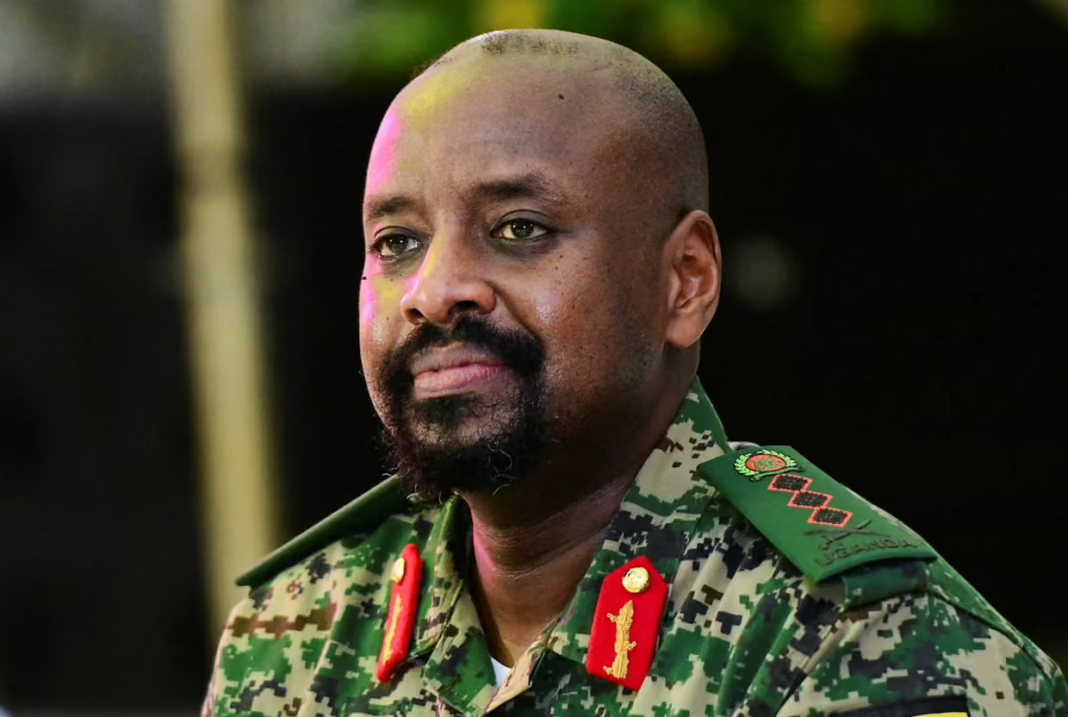
Gen Muhoozi Kainerugaba, Uganda’s military chief and son of President Yoweri Museveni, said his country would not participate in anything lacking the king’s approval and complained about what he called the ‘Harry-Meghan nonsense.’ Uganda had joined the Invictus community only in July as its 26th participating nation. At the time, its defence minister stood with Harry in London and praised Uganda’s leadership for championing the team’s entry. Two months later, wounded service personnel have been removed from an international sporting event because one government official decided the royal family tree required a foreign-policy response.
The timing matters. Buckingham Palace had just circulated formal guidance reiterating that Harry and Meghan are not working royals, that their charitable work is undertaken privately and that their position is akin to private citizens with commercial and charitable interests. This was meant to reduce ambiguity. It succeeded in the way a workplace memo succeeds when one employee reads ‘new parking policy’ and sells the car. The distinction may be constitutionally tidy in London. In Kampala, it apparently became a loyalty test.
The absurdity is not that Charles issued guidance. The monarchy has a legitimate interest in distinguishing official royal work from private activity, especially when famous relatives still carry royal titles. The absurdity is that the institution’s endless effort to define Harry’s exact distance from the crown keeps creating new things for everyone else to misunderstand. He is close enough to be the king’s son, famous enough for governments to care, distant enough to be officially private and royal enough that a military chief can cancel a sports team in Charles’s name.
Invictus makes the episode especially awkward because its purpose is not difficult to explain. Harry founded the Games in 2014 for wounded, injured and sick service personnel and veterans. The athletes are not participating in a constitutional seminar. Uganda’s team was not being asked to endorse Montecito, Netflix or anyone’s preferred interpretation of the Sandringham agreement. Yet the people most likely to absorb the consequences of the withdrawal are competitors who had been told they were joining an international community and then discovered they were supporting characters in somebody else’s royal grievance.
A source close to the Sussexes told The Sun that the withdrawal was a consequence of the palace guidance and argued that competitors would suffer. That is a partisan interpretation and should be treated as one. Kainerugaba made his own decision, and nothing in the palace letter instructed Uganda to leave Invictus. But the episode still demonstrates the strange reach of royal signaling. Buckingham Palace can write a careful note for British officials and discover that somewhere else a powerful man has converted it into an international sporting policy.
This is the monarchy’s recurring communications problem. The institution wants royal status to be precise when precision protects the brand, yet royal celebrity remains deliberately atmospheric when it benefits the brand. Working royals are official. Non-working royals are private. Former working royals retain titles. Charities may remain associated with them. Foreign governments may treat them as significant. Newspapers cover all of it as palace news. Then everyone acts surprised when the public cannot locate the exact constitutional border using a standard household ruler.
Uganda’s response is also a reminder that reverence for monarchy can become stranger abroad than it is at home. Kainerugaba attended Sandhurst and said he supports the monarch, period. That is his prerogative. But withdrawing wounded veterans from a competition because the founder’s father clarified the founder’s employment status is a spectacularly elaborate expression of loyalty. Charles did not request the gesture. Invictus is not a rival court. Nobody was asking Uganda to recognize King Harry I before the wheelchair rugby.
The palace may reasonably conclude that none of this is its responsibility. Formally, that is true. It cannot control how every foreign official interprets royal guidance. But institutions are judged not only by what their memos technically say, but by the ecosystem those memos enter. The Sussex settlement has become so layered with titles, security rules, private charity work and public symbolism that every clarification now seems to generate another clarification. Royal simplicity has acquired the administrative footprint of an airport. The Invictus Foundation itself is separate from the royal household, which makes the withdrawal even more revealing. Uganda was not being asked to participate in a palace program. It was joining an independent sporting organization created by Harry long before the latest letter. The decision therefore turns a constitutional clarification into a test of association, proving that royal status can remain politically potent even after the palace insists the work is private.
Harry and Meghan’s status needed a boundary, and Charles has every right to draw one. Uganda’s military chief had every right to make his own decision too. The result is that an event built for wounded service members has lost a participating country because the world’s most famous family separation still cannot remain a family separation. The monarchy wanted a cleaner line between official and private. It got a geopolitical footnote instead.
If the palace’s latest clarification was supposed to make the Sussex arrangement easier to understand, why did it just make Invictus harder to play?
Sources
The Guardian: Uganda to withdraw from Invictus Games ‘out of respect for King Charles’, says military chief
The Sun: Uganda pulls out of Invictus Games as military chief slams ‘Harry and Meghan nonsense’ amid Sussexes status row
The Sun: Harry and Meghan ‘blame King’s letter’ as Uganda withdraws from Invictus Games with move ‘clearly a consequence’