




The ceasefire between the United States and Iran expires on August 17. A senior Iranian source told Reuters on Wednesday that there are no ongoing discussions about extending it. The existing ceasefire has produced no movement toward the broader Strait of Hormuz deal that Trump described last week as “sort of open” and “moving along good.” It has produced no agreement on sanctions relief, which Iran has demanded as a precondition for any permanent resolution. It has produced no framework for the nuclear question that served as one of the original justifications for the conflict. It has produced five more days, and then it expires.
Iran’s military added a data point on Wednesday that complicates the American narrative about the war’s effectiveness. Iranian Army Deputy Commander for Executive Affairs Brig. Gen. Alireza Sheikh told state-run IRNA that “more than 75% of Iran’s missile and drone capabilities remain intact and ready.” He claimed that Iran’s drone fleet “has become the enemy’s nightmare.” This claim should be set directly against Trump’s July assessment, which he delivered to NBC News: “They have some missiles. They have some drones. Maybe 21%, 22% of their missiles.” Trump’s 22% and Iran’s 75% describe the same inventory. The distance between them represents what each side needs the public to believe about the war’s trajectory. The ceasefire expires in five days regardless of which number is accurate, because neither side has found the number that produces a deal.
The discrepancy matters beyond propaganda. If the US military’s targeting has genuinely reduced Iran’s missile capability to 22%, the calculus for further strikes is different than if Iran retains 75% of its capability and continues to pose a credible threat to shipping in two of the world’s most important maritime chokepoints. The Pentagon has separately reported to Congress that missile stockpiles used in the Iran campaign have been significantly drawn down, and that production timelines for replacement precision munitions are measured in months, not weeks. A military that has depleted its own stockpile while believing it has reduced Iran’s to 22% is in a different strategic position than a military that has depleted its own stockpile while Iran retains 75%. The gap between the two narratives is not academic.
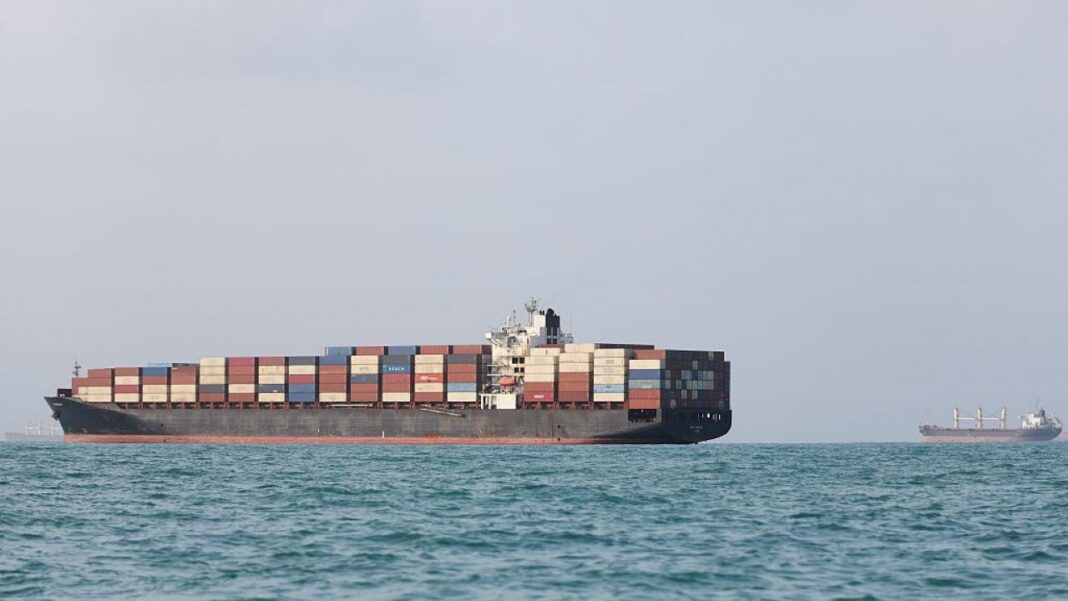
The operational reality on the water on Tuesday was consistent with a war in progress rather than a ceasefire in effect. The US Navy fired on a Panama-flagged commercial vessel that was attempting to bypass the American blockade of Iranian ports, per Fox News’s confirmed live blog. The vessel was making for Iranian waters in violation of the blockade that CENTCOM has maintained since the early weeks of the conflict. The Navy fired warning shots and the vessel stopped. The incident is the kind that occurs when a naval blockade is being enforced against a global shipping network that has an economic incentive to find workarounds. Separately, Iran-backed Houthi rebels in Yemen fired on a commercial vessel in the Bab el-Mandeb strait, the waterway connecting the Red Sea to the Gulf of Aden through which a significant portion of globally traded goods passes. The Houthis killed six people on the vessel. Six people on a commercial ship died in a strait that was supposed to be calming down while negotiations proceed in Oman.
The Bab el-Mandeb is the second maritime chokepoint to become a conflict zone in this war, alongside the Strait of Hormuz. Before the conflict, the two straits together facilitated the passage of approximately 40% of globally traded oil and a significant fraction of global container shipping. Both are now zones of active military interdiction. The Houthi attack capability has proven persistent despite US and Saudi airstrikes targeting Houthi positions in Yemen. Iran delivered military capabilities to the Houthis, including weapons, training, and gold for funding, during a resupply operation in July that US forces did not interdict despite tracking the shipment. The Houthis used what that shipment delivered to attack commercial vessels in the Red Sea. Tuesday’s attack in the Bab el-Mandeb used the same operational model.
Trump confirmed on Wednesday a story that had been circulating since late July: that he was covertly rerouted between aircraft during his return from the NATO summit in Turkey, using a catering truck as cover to make it appear he was boarding the official Air Force One while Secret Service moved him to a different military jet. The maneuver was a direct response to intelligence about an Iranian assassination threat against the president. “Well, it’s only up to the Secret Service. I just follow what they’d like to do,” Trump told reporters in Geneva, Ohio, where he had traveled for the Freedom 250 Patriot Games. “I get a lot of threats. Non-consequential presidents don’t get threats — and I think that I’m maybe the most consequential president.”
The Secret Service’s use of a catering truck as a presidential decoy reflects a threat assessment that is specific and operational enough to require immediate improvisation of cover story logistics. A catering truck is a vehicle that belongs in an airport environment and that provides visual cover for personnel movement without attracting the attention that would accompany a more obvious security protocol change. That the Secret Service deployed this specifically in response to an Iranian assassination threat, in a country whose government has publicly called for Trump’s death on multiple occasions and whose proxies have maintained an ongoing military conflict with the United States for more than five months, is the context that Trump summarized as “I get a lot of threats” before describing himself as the most consequential president.
The ceasefire expires in five days. The senior Iranian source told Reuters there are no talks to extend it. Iran claims 75% of its missiles remain. Six people died on a commercial vessel on Tuesday. The president was moved between planes via catering truck in Turkey last month to evade an assassination attempt.
When the ceasefire expires in five days with no extension talks, Iran claiming three quarters of its arsenal intact, and the president being moved through airports via catering truck to evade assassination, what exactly is the peace process tracking?
Sources
Fox News live: Iran ceasefire, missile claims, Hormuz, August 12