



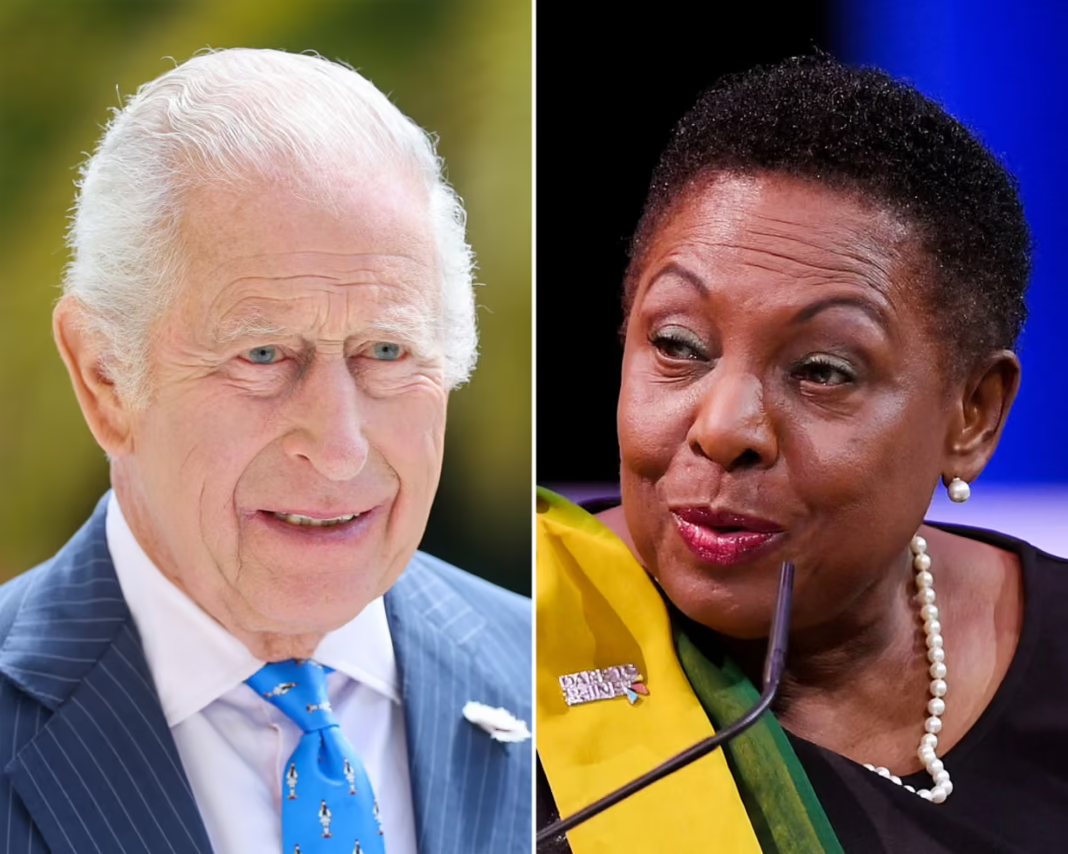
King Charles has spent years trying to make the monarchy look like a modern institution without performing the one trick that modern institutions eventually have to perform: opening the old files and discovering what the brand was built on. This week, Jamaica delivered the paperwork. A delegation led by culture minister Olivia Grange arrived in Britain to present Charles with a formal petition seeking legal guidance on slavery reparations. Not because he is merely a famous British man with excellent stationery, but because he is still Jamaica’s head of state. The crown has discovered that being ceremonial is wonderfully relaxing right up until somebody uses the ceremony to hand you a bill.
The petition asks Charles to refer legal questions to the judicial committee of the Privy Council, including whether the forced transportation of Africans to Jamaica was lawful, whether it constituted a crime against humanity and whether Britain has an obligation to provide restitution. Grange has argued that slavery’s legacy continues to damage Jamaica in education, health, infrastructure and climate resilience. This is not a random protester shouting at a carriage. It is a government delegation asking the king, through the machinery that monarchy itself preserves, to help examine the legal consequences of the empire whose symbols the monarchy still wears for work.
That creates an exquisite institutional problem. The modern royal family likes history when history arrives polished, roped off and accompanied by a plaque. History is castles, jubilees, regimental uniforms, antique coaches and the occasional tapestry that proves Britain has been doing complicated things with France for a very long time. Reparations history is less decorative. It asks who profited, who was governed, what institutions survived and whether the current holders of inherited authority have obligations beyond saying that the past was deeply regrettable. Suddenly the family business is being asked to read the terms and conditions.
Charles has moved further than some predecessors in acknowledging slavery’s horrors. He has spoken about the enduring impact of slavery and the need to understand the darkest parts of shared history. That language matters. It is also the royal equivalent of standing near the swimming pool in a suit and announcing strong support for water. Jamaica’s petition asks for a procedural act, not another adjective. The question is whether a monarch who has encouraged historical reckoning is willing to let that reckoning travel through an institution over which the crown still has a formal role.
The palace cannot simply solve reparations, of course. Britain’s government controls public money and policy. Legal responsibility is complicated. The scale of any restitution debate is enormous, and there is no magic royal cheque book tucked behind the Crown Jewels. But that is exactly why the petition is such an effective piece of constitutional theater. The monarchy has spent decades defending itself as useful because it provides continuity. Jamaica is now testing the warranty. If continuity is the selling point, continuity includes the awkward chapters too.
There is another complication. Charles is king of Jamaica because Jamaica remains a constitutional monarchy, even as republican sentiment has grown and the government has pursued plans to remove the British monarch as head of state. That means the petition arrives during a larger argument about what the crown is for. A head of state who cuts ribbons and receives ambassadors is easy to explain. A head of state who represents centuries of constitutional continuity but becomes suddenly non-operational when that continuity generates a difficult legal request is harder. At some point, symbolic power has to decide whether it is power or just very expensive typography.
The monarchy’s defenders may reasonably say Charles should stay out of politics. That principle has protected the crown for generations. Yet the institution is also praised whenever Charles uses his position to encourage dialogue on climate, faith, community or reconciliation. The job description therefore has a fascinating elasticity. The king may be a moral voice when the subject is broad enough to fit comfortably inside a banquet speech, but a neutral constitutional ornament when the conversation acquires a case number. The crown can apparently carry history, provided history remains under the weight limit.
Jamaica’s move also exposes why reparations debates are so difficult to contain with ceremonial language. The petition does not require everyone to agree on a cash figure tomorrow. It asks whether legal institutions should examine specific questions about forced transportation, crimes against humanity and restitution. Those questions will not disappear because the palace prefers reconciliation to arrive as a theme. Once a government formally asks the crown to engage its own constitutional machinery, the response itself becomes part of the record.
For Charles, this may be the least glamorous version of the modernizing monarchy he says he wants. Slimmer payrolls and fewer working royals are easy modernization. Confronting what inherited institutions owe to people who experienced the other side of inheritance is harder. The crown’s greatest asset has always been continuity. It connects the present to the past and turns that connection into legitimacy. Jamaica has simply noticed that a bridge works in both directions.
The palace can receive the petition, acknowledge the pain, consult the government and proceed with all the careful choreography expected of a constitutional monarch. But the deeper issue will remain after the delegation leaves and the cameras move on.
If the monarchy wants the authority that comes from embodying centuries of British history, how much responsibility comes bundled with the costume?
Sources
The Guardian: Jamaican delegates arrive in UK to hand slavery reparations petition to King Charles
The Guardian: Jamaican delegation to travel to UK to lodge formal slavery reparations petition with King Charles