



Republicans have spent months warning that Democrats are socialists, communists and occasional Bolsheviks. Apparently the vocabulary was not landing hard enough. As Muslim candidates win prominent Democratic nominations, the attack has moved from what they believe politically to the useful fact that they are Muslim. The Guardian documents a wave of anti-Muslim rhetoric aimed at candidates including Michigan Senate nominee Abdul El-Sayed and New York mayor Zohran Mamdani. The party that says identity politics has gone too far has found an identity it would very much like voters to discuss.
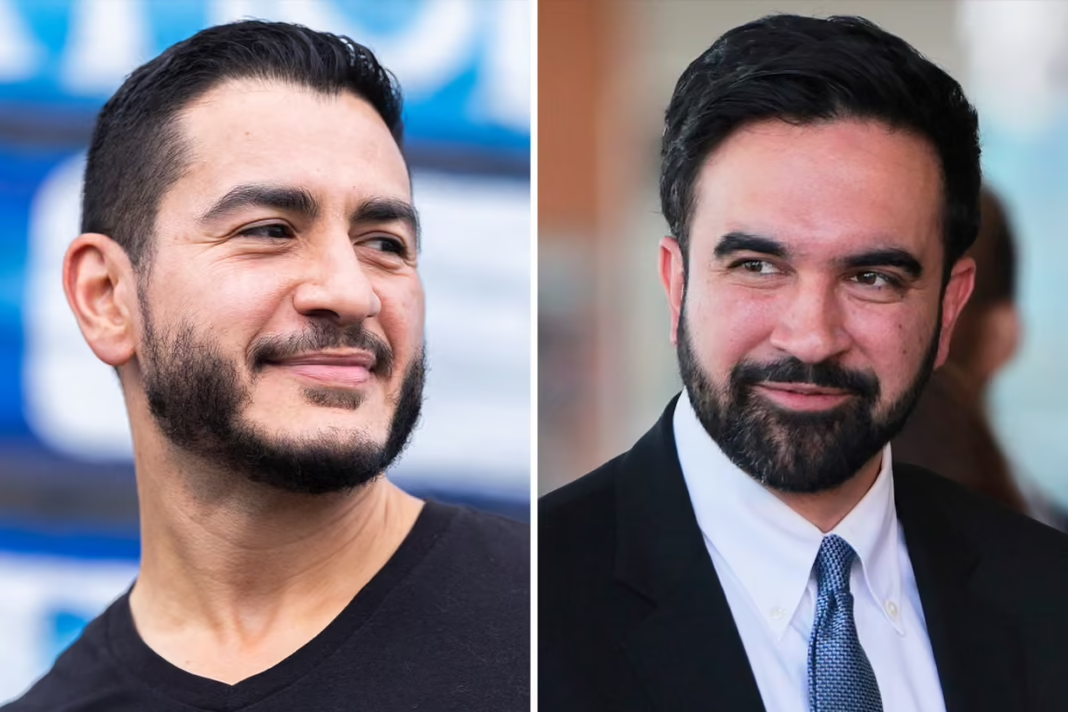
The most efficient example came from Alabama senator Tommy Tuberville, who responded to El-Sayed’s primary victory by calling him a terrorist and a radical Islamist. El-Sayed is a physician, former Detroit health director and Democratic Senate nominee. He is also Muslim, which appears to be doing extraordinary amounts of work in some Republican campaign copy. When your opponent has a tax plan, healthcare proposals, foreign-policy positions and a long public record, reducing the argument to the scary version of his full name is not opposition research. It is a font choice.
There are real reasons for Republicans to challenge El-Sayed. Fox News has pressed him on past statements involving Sharia law, taxation and white supremacy. He has had to answer for his association with Hasan Piker and for comments Republicans say are far outside the mainstream. Good. That is politics. Candidates should be interrogated about what they have said, whom they have embraced and what policies they would enact. None of that requires implying that a Muslim nominee is a security threat because his faith can be made to sound foreign at a campaign rally.
The distinction matters because the right has spent years saying it wants politics to be less obsessed with race and identity. The preferred conservative ideal is supposed to be individual judgment. Judge the candidate by the record. Judge the policy by the result. Then a Muslim wins a primary and suddenly a remarkable number of elected Republicans become enthusiastic amateur ethnographers. Identity politics was apparently bad because somebody else owned the trademark.
The strategy is not subtle. Anti-Muslim rhetoric has been used around Mamdani, El-Sayed and other Muslim officials as their visibility has grown. Critics interviewed by The Guardian say the climate resembles the post-9/11 era, when Muslim Americans routinely had their loyalty questioned as a condition of public life. Twenty-five years after politicians learned that lesson badly, some have decided nostalgia is a campaign platform.
Republicans can insist they are attacking ideology rather than faith. Sometimes they are. El-Sayed is progressive. Mamdani is a democratic socialist. Their positions invite sharp disagreement. But rhetoric about terrorism, Sharia takeover and whether Muslims belong in American political life has a habit of revealing what the argument is really selling. If the policy critique were sufficient, nobody would need to put a crescent moon around it.
This is also strategically lazy. Republicans face voters worried about prices, housing, healthcare and the economy. They have a Democratic socialist movement handing them pages of policy to criticize. Yet some of the party’s loudest voices keep returning to religion as a shortcut. It is easier to make a name sound ominous than to explain why a housing policy would fail. The first fits in a post. The second requires knowing how housing works.
The broader conservative movement should be especially careful here because religious liberty is one of its foundational arguments. Conservatives correctly object when Christian belief is treated as evidence of political extremism. They defend the right of believers to bring faith into public life without passing a secular purity test. That principle either applies before the name Abdul appears on the ballot or it is not much of a principle.
There is plenty to roast in the Democratic left without turning the Constitution into a guest list. If El-Sayed wants higher taxes, argue about taxes. If Mamdani wants public ownership, argue about public ownership. If a candidate keeps questionable company, put the clips on television. Democracy has an almost suspicious number of available arguments before religion becomes a disqualifier. That tension is what gives the story a thread beyond the headline. The immediate event is funny because the facts are funny, but the larger question is institutional. Once a public institution builds its legitimacy around a principle, moments like this test whether the principle survives when it becomes inconvenient. The significance is not confined to the day’s headline. It shows what happens when an institution’s public argument collides with the incentives, traditions or contradictions that institution normally keeps offstage. That collision is where the story stops being a curiosity and becomes a test of whether the stated principle survives ordinary pressure.
The uglier consequence is that religious targeting does not stay neatly inside campaign strategy. When public officials repeatedly associate Muslim identity with terrorism or disloyalty, ordinary voters hear a permission structure larger than one Senate race. That is why the standard has to be behavior. Criticize candidates aggressively. Quote their worst lines. Ask hard questions about associations. But once faith itself becomes evidence, the argument has left policy and entered a place conservatives normally insist government should not police. The midterms will tell Republicans whether this line of attack energizes more voters than it repels. It may work in some places. Fear often does. But a party that claims to oppose identity politics should eventually explain why a Muslim candidate’s identity keeps becoming campaign material whenever the policy case gets crowded.
If Republicans really want voters to judge candidates by ideas instead of identity, why does a Muslim candidate’s religion keep becoming the easiest idea to campaign against?
Sources
The Guardian: ‘It’s just straight bigotry’: Trump leads wave of Islamophobic rhetoric as midterms loom
Fox News: Michigan Senate nominee El-Sayed defends Sharia law views in fiery interview
The Independent: Trump ally pressed on Obama and El-Sayed trend: ‘Trying to say, hint hint, he’s Muslim?’