



Donald Trump has spent months trying to get a federal court out of the way of his plans to transform a public golf course in Washington. Now, according to the president’s latest interpretation of events, even God may have entered the dispute. After a Thanksgiving storm brought flooding to East Potomac Park, Trump took to Truth Social to describe the damage as divine intervention and renew his demand that a judge allow the project to proceed.
There is one particularly inconvenient detail. CNN sent journalists to the golf course Saturday morning and found that parts of it were still playable, with golfers out on the course despite the remaining water. The president’s dramatic assessment and the sight of people continuing their rounds make for one of the more unusual disputes over the condition of public property in recent memory.
Trump’s Heavenly Argument for a Golf Course
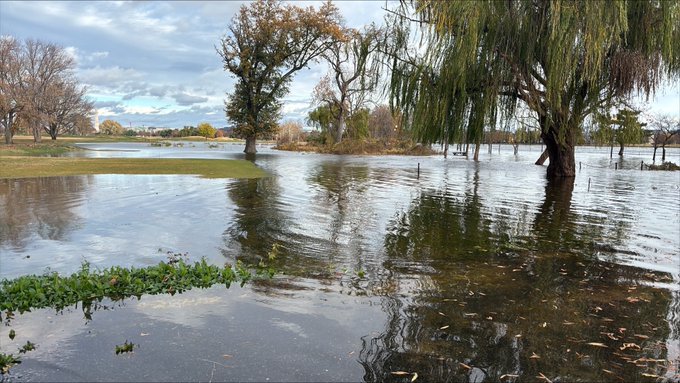
On November 28, Trump posted photographs of flooded parkland and described the area, which he has derisively nicknamed Trash Island, as devastated. He said seawalls had collapsed and much of the surrounding property was under water. Then he connected the weather event to his frustration with the federal judge handling the legal dispute over his plans.
“God must have been watching the problems we’ve been having,” Trump wrote before arguing that the flooding amounted to an act of God. He suggested that the storm illustrated the need for his plans, particularly improvements to the seawall protecting the low-lying property. He also renewed pressure on the judge to let the administration move ahead.
An act of God is an expression people commonly use to describe exceptional natural events. The striking element in Trump’s post was the suggestion that the weather had arrived as a helpful intervention in his particular disagreement over a golf course. If thunderstorms start getting assigned to Washington’s litigation teams, the federal courts may need a meteorologist in every courtroom.
CNN Finds Golfers on the Supposedly Destroyed Course
There is no question that a major storm affected the Washington area over Thanksgiving. East Potomac Park is vulnerable to flooding, and the pictures Trump posted showed real areas of standing water. The issue is how much damage the storm did to the park and whether that damage supports his claim that the site can no longer function safely.
CNN reported that its journalists found relatively limited flooding on the golf course Saturday morning. Some golfers were playing despite wet areas. The network did not establish precisely when the photographs posted by the president had been taken, so the pictures and the subsequent visit could reflect different stages of the storm and its aftermath.
The network’s observation also does not amount to a comprehensive engineering assessment. A round of golf is not a substitute for a structural inspection of a seawall, and some portions of a park may remain usable while others are unsafe. But the available evidence falls short of independently demonstrating that the entire golf property was obliterated as Trump claimed.
The distinction matters because the photographs are being used as an argument for a much more extensive project than repairing whatever the storm actually damaged. There is a perfectly legitimate conversation to be had about improving a vulnerable waterfront. It is quite another thing to treat a weekend of bad weather as the final word on a disputed golf-course redevelopment.
The Judge Has Not Banned Necessary Repairs
The dispute involves East Potomac Park, a public recreation area built on reclaimed land near the Potomac River. Its historic golf facilities have been available to generations of Washington residents. Trump wants a championship-quality facility capable of accommodating major events, a substantially different proposition from the current arrangement of public courses.
U.S. District Judge Ana Reyes has temporarily prevented the administration from shutting the park and course during their established open hours while a legal challenge proceeds. On November 23 she extended the temporary order through December 12. The plaintiffs argue that the administration’s plans and the way it has pursued them run afoul of legal protections for the park and public access.
According to the Associated Press’s reporting on the original November 14 ruling, Reyes specifically left room for appropriate repairs, subject to the existing court requirements. The Justice Department likewise noted that the National Park Service can restrict access where genuine safety risks exist and that planning for the proposed course is not prohibited by the temporary order.
That is a rather important distinction in light of the president’s Saturday argument. The administration is not necessarily being forced to leave a damaged seawall untouched until the judge personally approves every future tee box. There are legal mechanisms available to deal with unsafe conditions. The wider argument is about how far the administration can go with its redesign and closure plans before the court considers the challenges to them.
A Real Infrastructure Problem Meets a Political Deadline
CNN reported that the island has long faced problems associated with its low elevation and deteriorating waterfront protection. A National Park Service inventory in 2023 documented increasingly frequent flooding along the promenade compared with historical conditions. There is support across the political divide for addressing the seawall problem, even among people who oppose Trump’s proposed transformation of the golf facility.
There is also a practical reason the administration is keen to move quickly. The National Capital Planning Commission is expected to hold a special meeting on December 31, and CNN reported that final approvals for several major Trump projects could be considered. Changes to the commission’s political composition in January may make those projects harder to advance. The court has a December 8 hearing scheduled in the golf-course dispute.
Whether the president can achieve his plans will turn on the evidence, applicable laws and decisions made through the relevant public institutions. A severe storm may provide useful evidence of an existing infrastructure problem, but it does not resolve questions about historical preservation, environmental review or the future of public access. Those questions remain even after the water recedes.
For the time being, the president has offered his interpretation of the storm, the judge’s temporary order remains in effect, and at least some Washington golfers were able to get back out on the course. The rest of the argument will have to play out in the ordinary earthly venues of judges, lawyers and planning commissioners. Whatever the heavens may have intended, federal litigation has not yet adopted divine intervention as an alternative to submitting evidence.
Sources
- Trump’s Truth — Archived November 28 statement and photograph
- CNN via KVIA — On-the-ground reporting, flooding and planning timeline
- Associated Press via ABC News — Judge’s initial temporary order and repair provisions
- Washington Post — November 23 extension of temporary order
- New York Post — Trump’s flooding claims and redevelopment dispute