




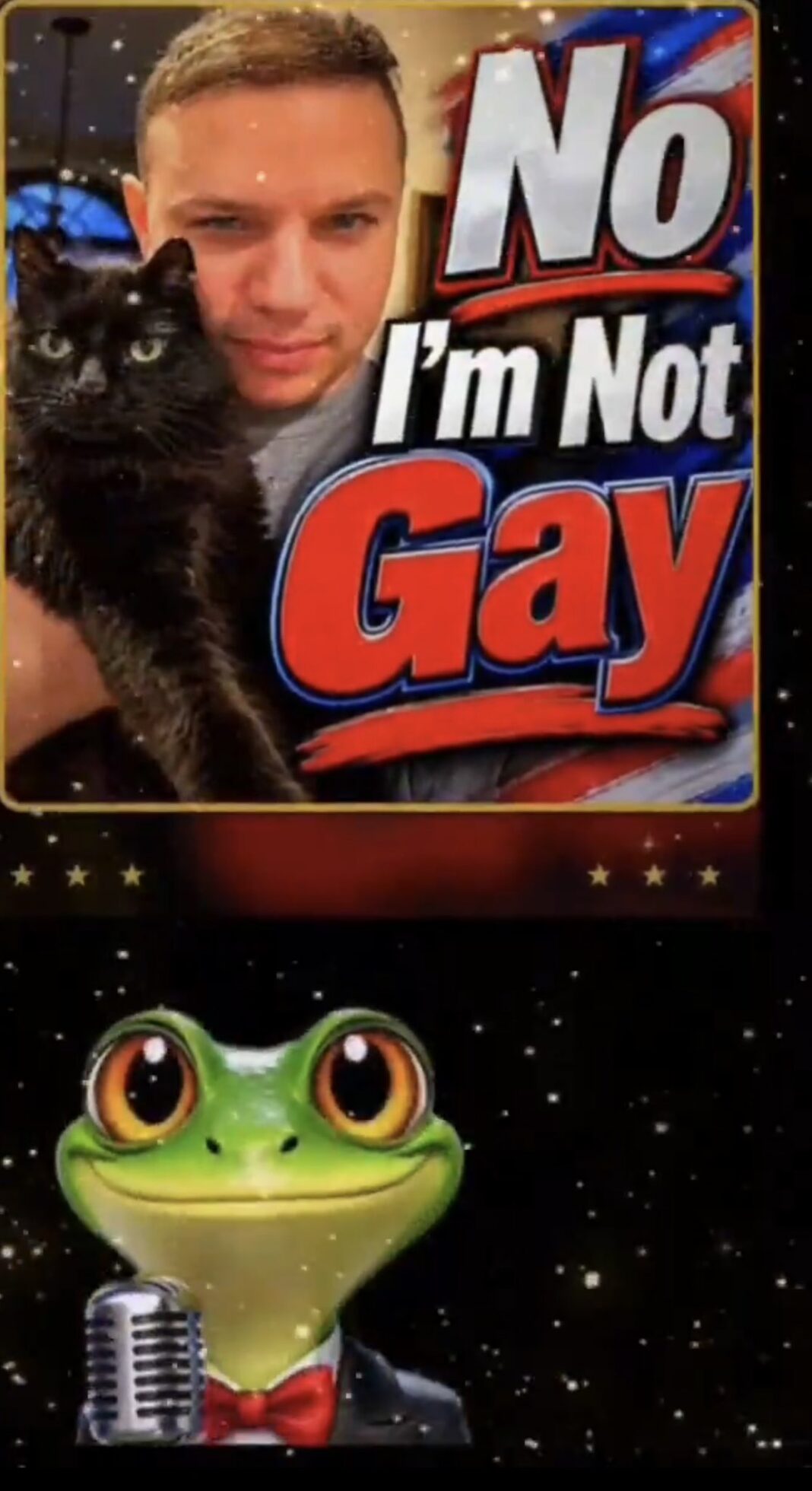
Anthony Constantino has not even taken his seat in Congress, and he has already found a way to make a cartoon frog part of the national political conversation. The New York Republican congressman-elect posted an AI-generated music video Friday in which a frog wearing formal evening attire delivers an urgent clarification: the incoming lawmaker is straight. The frog also has a message for gay Americans: become Republicans.
There are plenty of ways to introduce yourself to voters who might not know much about you. A biography, a policy speech, a town hall or even a reasonably well-produced campaign commercial would have done the job. Constantino, who has been publicly discussing his ambitions to recruit gay voters, apparently preferred to let an amphibian in a tuxedo handle the next phase of communications.
The Frog Has an Announcement
Constantino shared the animated video on X on November 27. According to the Albany Times Union, it went up in the early hours of Friday morning. The cartoon performer sings into a microphone, repeatedly making clear that Constantino is not gay while encouraging gay people to support the GOP. Photographs of the congressman-elect appear as part of the performance.
The title of Constantino’s social media post was as direct as the song: “I’m not Gay!” Mediaite reported that the music was AI-generated. Whoever assembled the clip certainly understood one basic principle of advertising: repeating a message makes it harder to forget. Whether every part of this particular message needed repeating is another question altogether.
Nothing about being gay or straight requires a musical defense. Constantino has told people how he identifies, and there is no reason to treat the song as evidence to the contrary. The funny part is the production decision, not anyone’s sexuality. Most elected officials would issue a sentence of clarification; this one has delivered what amounts to a nightclub act starring a frog.
How a Political Pitch Became a Personal FAQ
The video was the culmination of several days of posts about Constantino’s desire to win over gay voters. He has talked about that outreach as an ambitious goal for his time in Congress, and his posts have framed it as a contest with Democrats. His stated pitch is that people who want lower taxes, fewer regulations, safer communities, border security and constitutional protections should support the Republican Party, regardless of their sexual orientation.
That is a recognizable political argument. Both major parties spend considerable energy trying to reach people who do not ordinarily vote for them, especially when elections are close. Constantino could have spent the week discussing how he would translate those priorities into legislation or how he would persuade voters who disagree with Republicans on LGBTQ issues.
Instead, the discussion became sufficiently focused on Constantino himself that Newsmax host Greg Kelly asked him about his sexual orientation during an interview. Constantino said he was not gay and argued that it was irrelevant to his political philosophy. He tried to return the conversation to his ideological reasons for courting the voters.
By Friday, the congressman-elect had gone a step further. The interview answer was now a musical number. It is difficult to imagine a campaign consultant’s presentation beginning with standard demographic outreach and ending with an AI-generated amphibian, but modern political communications has an impressive capacity for surprise.
The Newly Elected Republican Has a Real Political Challenge
Constantino won New York’s 21st Congressional District in the November 3 election. Ballotpedia lists him as the incoming Republican representative, scheduled to take office January 3, 2027. The district covers a substantial portion of northern New York, and his victory over Democrat Blake Gendebien was narrow.
Winning over new voters is therefore a perfectly understandable objective. Even a relatively small shift in support could matter in competitive races. Constantino’s argument is that Republican economic and public-safety policies can attract voters who might otherwise identify with the Democratic Party.
The obstacle is that LGBTQ voters are not a single political personality. Some prioritize economic issues, others care deeply about legal protections and civil rights, and many have a mix of concerns that cannot be reduced to a party-registration slogan. The Times Union noted that survey data has historically shown a substantial Democratic advantage among lesbian, gay and bisexual voters. Changing those preferences would take more than a catchy tune.
There is also a distinction between welcoming people into a political coalition and assuming they should all arrive at the same political conclusion. Constantino can make his case, but his prospective audience gets to decide for itself. The fact that he has set himself an extraordinarily broad recruitment target is part of what makes the strategy so conspicuous.
When the Messenger Becomes the Story
Political campaigns have embraced artificial intelligence for everything from graphics and fundraising material to strange pieces of online entertainment. The technology lowers the cost of making a professionally styled video, but it does not automatically provide the judgment to decide whether that video should be made. With a few tools, a politician can now create something that would once have required an entire animation studio and at least one uncomfortable meeting with the communications director.
For Constantino, the immediate risk is not that voters will misunderstand the frog’s lyrics. They are emphatically clear. The risk is that people remember the amphibian and forget every substantive point he was trying to make about Republican policy. A video can attract attention without necessarily persuading anyone, and there is no reliable evidence yet that this clip has converted a single voter.
It is possible that the unusual approach helps Constantino reach people who would never watch a conventional political interview. It is equally possible that the joke will crowd out the argument. Those are separate questions, and an internet reaction should not be mistaken for a measure of electoral success.
The congressman-elect has another month before the new Congress convenes. He has time to decide how much of his outreach will involve legislation, interviews and actual conversations with the people he hopes to represent. At least one aspect of his political brand is already firmly established, though: if Washington needs someone to put a political clarification to music, he knows a frog who can do it.