



Donald Trump has found a new reason to get annoyed at Fox News, and this time the offense is not a polling number, an unfriendly panelist or a correspondent asking an inconvenient question. Shannon Bream used the words artificial intelligence. In a country where virtually every discussion about chatbots, computer-generated videos and automated software involves those words, the president has decided the familiar terminology needs to go.
Trump took to Truth Social on Saturday to complain that Bream kept saying AI during a program about the technology. He wants it called super intelligence, or SI, and suggested that Securities and Exchange Commission Chairman Paul Atkins would soon require the new terminology. Fox News veteran Brit Hume promptly objected to the idea that the government could dictate what people call things.
The President Is Taking This Personally
In his November 28 post, Trump singled out Bream and complained about her repeated use of the adjective artificial. He told someone to explain his preferred wording to her and described the replacement as a matter of linguistic accuracy. The president was not simply offering a catchy alternative for people who happen to like it; he was predicting that the SEC chairman would make it compulsory.
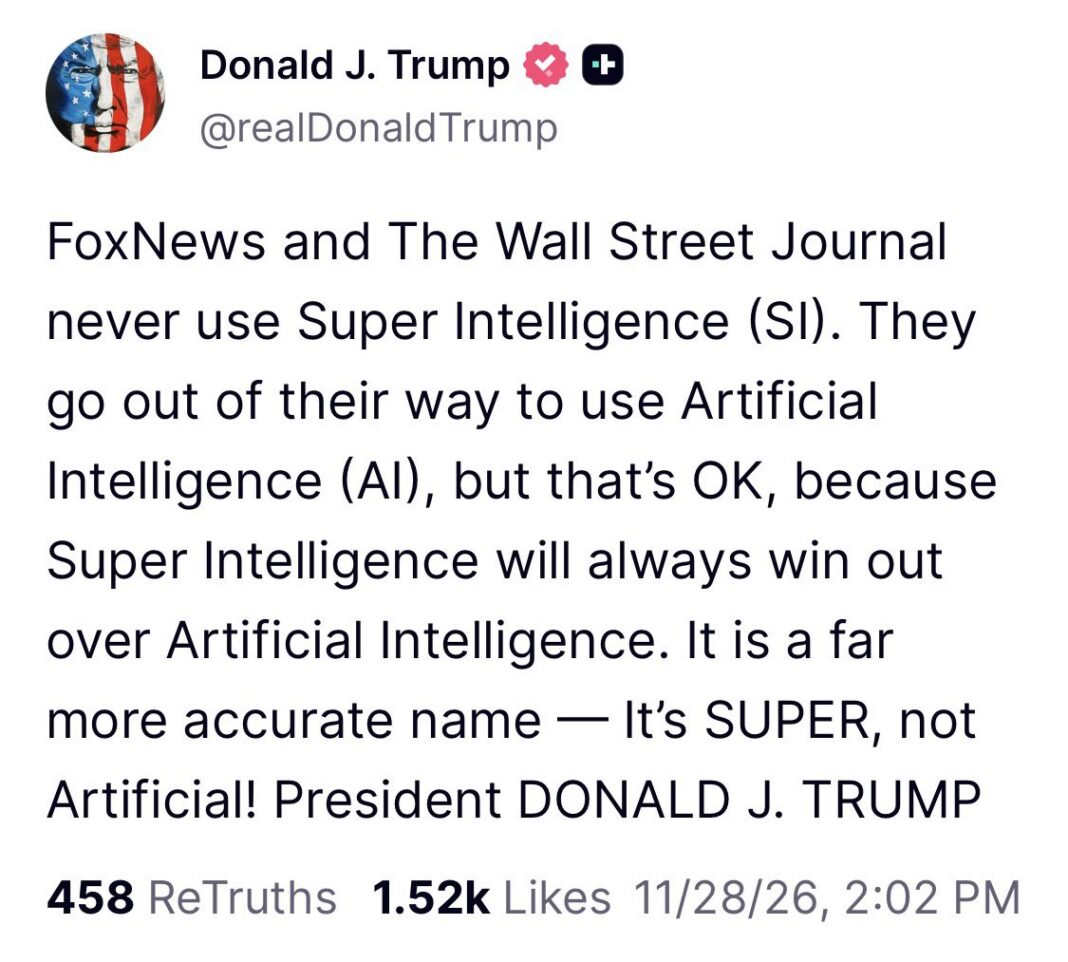
Trump also criticized the Wall Street Journal and Fox News in another post for continuing to use the established term. He suggested the two outlets were deliberately choosing the older language rather than adopting his preferred label. There is a much less complicated possible explanation: it is still the term their audiences know.
The situation is particularly amusing because Bream is a Fox News anchor, not a spokesperson for a tech company hired to market its newest product. She was discussing a category of technology using the expression that has been attached to that field for decades. Normally, a television journalist referring to artificial intelligence would be about as controversial as a weather presenter referring to rain.
The AI Rebrand Is Actually Official — in Parts of Government
Believe it or not, Trump’s obsession with the terminology is not just a weekend social media tangent. On September 29, he signed an executive order directing federal executive departments and agencies to replace AI with SI in a variety of their official communications, subject to legal limits. The White House says the change better communicates the transformative potential of today’s technology.
The administration’s directive covers government websites, policy materials, correspondence and other specified documents. It also calls for work on a new federal definition of the preferred term. Until a lawful replacement is adopted, the order essentially points back to the existing statutory definition of artificial intelligence. In other words, Washington is temporarily using a new label to describe a category the old label already described.
The government has not simply forgotten about the order. NASA, for example, explains on its website that it is updating its language in accordance with the directive. Treasury has also published a proposed regulatory change using the administration’s terminology. So federal employees really do have a new set of editorial instructions to deal with, although the order does not automatically rewrite every historical document or existing law.
What the order does not do is require a television presenter, newspaper columnist or ordinary American to adopt Trump’s language. That is where the Saturday complaint becomes a much bigger issue than government stationery.
Brit Hume Introduces an Awkward Constitutional Detail
The pushback came from a particularly interesting place. Hume, a longtime Fox News political journalist, responded on X by arguing that Trump can use the expression he prefers and everyone else is entitled to keep using AI. He rejected the idea that a government agency could require the public to adopt the president’s chosen name.
His response points to a distinction that is easy to lose in the shouting. The executive branch can establish conventions for its own communications within the scope of the law. Regulating the language of private news organizations is a different matter, implicating protections for speech and the press. The SEC regulates securities markets; it is not a national department of vocabulary.
There could, of course, be specific technical definitions adopted in securities regulations or disclosure requirements through lawful procedures. That would not be the same thing as forcing news anchors to speak a certain way on television. No rule requiring Bream or private news outlets to say SI has been established by the reporting on Trump’s posts, and his claim about Atkins should not be treated as an announcement that such a rule already exists.
Former Republican congresswoman Marjorie Taylor Greene joined the pushback, according to Benzinga. She appealed to the First Amendment and deliberately typed the disfavored phrase several times. Hume and Greene hardly represent the same corner of Republican politics, but both objected to the idea of the president policing vocabulary.
Atkins himself has used the administration’s preferred expression in public: a November 9 SEC roundtable on financial data featured it in the event title and his remarks. That confirms the chairman has adopted the branding, not that the commission has imposed a rule on how private journalists must speak.
The Difference Between Artificial and Super
There is a technical reason why plenty of people in the technology world may be reluctant to make the switch. Artificial intelligence describes a broad class of computer systems, including tools that perform tasks involving pattern recognition, language or decision-making. The term artificial identifies the fact that these are engineered systems. It does not automatically mean that their output is poor or that their capabilities are imaginary.
Superintelligence, by contrast, is often used in technical discussions to describe a much more ambitious concept: intelligence that substantially surpasses human abilities across a range of domains. Definitions vary, but treating every existing AI product as superintelligence can blur the difference between present-day tools and speculative future capabilities. Renaming a system does not improve its performance, any more than naming a minivan a spaceship gets it into orbit.
Mediaite reported that the modern presidential branding exercise followed a September social media poll and that Trump later pressed the Wall Street Journal to adopt his chosen terminology. The administration is entitled to argue that a different name better captures its ambitions. Scientists, businesses and journalists are equally capable of deciding whether they find that argument convincing.
For now, Bream has been publicly rebuked for using a familiar technical term, Fox News has produced an internal dissenting voice, and the president’s language campaign has become another news story about presidential power. The technology itself remains exactly as capable as it was before the Saturday posts. Somewhere, a computer is probably still struggling to count the number of letters in a word. Giving it a more flattering job title is unlikely to help.
Sources
- Trump’s Truth — Archived November 28 statement targeting Shannon Bream
- Mediaite — Trump’s criticism and history of the terminology dispute
- Just the News — Trump’s statements and Brit Hume’s response
- The White House — September 29 executive order on super intelligence
- NASA — Agency terminology and definition
- Federal Register — Treasury’s proposed regulatory terminology
- SEC — Paul Atkins’s November 9 remarks
- Benzinga — Marjorie Taylor Greene’s First Amendment response
- IBM — Technical meaning of artificial superintelligence