



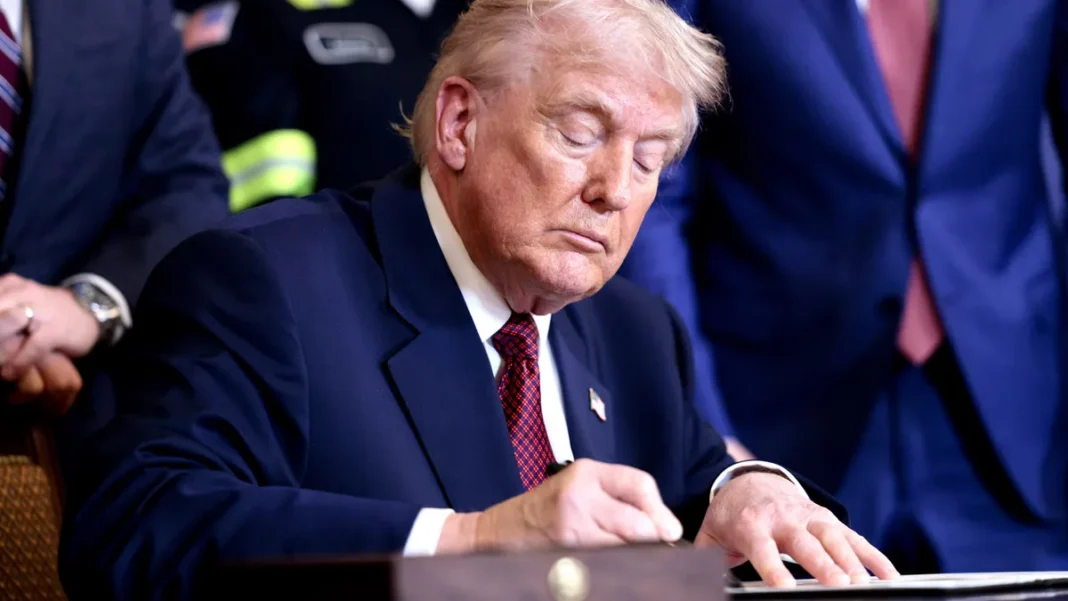
The Trump White House just signed an executive order that gives federal agencies 30 days of exclusive access to AI frontier models before they go public. No fanfare. No press conference. Just a signature on the “Promoting Advanced Artificial Intelligence Innovation and Security” order, and suddenly the US government has unprecedented control over the pace and content of AI development.
The timing is notable. There are no national AI regulations in the United States. State-level efforts are piecemeal and mostly incomplete. Into that vacuum, the White House has inserted itself as gatekeeper for OpenAI, Meta, Anthropic, Microsoft, and every other major AI lab operating on American soil.
The major AI companies appear to support the order in principle. They also appear caught off guard. OpenAI CEO Sam Altman posted a Bible verse on X at roughly the same time Trump signed the order, quoting Ecclesiastes 9:10 about doing work “with all your might, for in the realm of the dead, where you are going, there is neither working nor planning nor knowledge nor wisdom.” Whether that was commentary on the executive order or just a coincidence is unclear. Either way, it didn’t radiate confidence.
The ostensible goal is cybersecurity, but the scope is wider than that
The order allows the Department of War, the NSA, and other trusted government partners to examine AI models for threats to cybersecurity or infrastructure. The proximate cause may have been Anthropic’s release of its Mythos model, which reportedly could identify hidden vulnerabilities in almost any software. That kind of capability in the wild is a problem. Nobody disputes that.
The issue is what else the government might look for during those 30 days. The order doesn’t specify how agencies will conduct their reviews. It doesn’t define what counts as a disqualifying risk. And it comes from a White House that has been explicit about its positions on DEI, content moderation, and the role of institutions in shaping public discourse.
The question isn’t whether the US government should have some oversight of models that could break encryption or destabilize critical systems. The question is whether this White House, or any single administration, should be the entity making those calls without external review, bipartisan input, or clear limiting principles.
The competitive pressure is real, and delays have consequences
New AI models are being released almost monthly. Reports indicate Chinese labs are closing the gap with Western frontier models. A 30-day delay for government vetting could slow the pace of releases from US-based companies and allow competitors in other jurisdictions to gain ground. That matters in a technology race where being first often means setting the standard.
The companies building these models are now caught between two pressures. On one hand, they want to remain competitive and maintain the trust of their users and partners. On the other, they’re now required to hand over their most advanced work to a government that has made its policy preferences unmistakable.
The comparison to China’s tech oversight is uncomfortable but not irrelevant. ByteDance was required to give the Chinese government access to its algorithm. That requirement was one reason the US government viewed TikTok as a national security risk. Now the US is implementing a version of the same model, and global partners may reasonably begin to wonder what the government is doing with that access.
Regulation from a partisan actor isn’t the same as neutral oversight
Ideally, AI regulation would come from an independent body with no stake in culture-war outcomes. It would focus on narrow technical risks: cybersecurity vulnerabilities, infrastructure threats, verifiable harms. It wouldn’t have the authority or the interest to scrub models for ideological compliance or penalize outputs that conflict with the administration’s preferred narratives.
That’s not what this order creates. It creates a system in which one branch of government, led by one administration, has the power to delay or demand changes to models that millions of people will eventually use. Those models aren’t just technical tools. They’re conversational agents that users turn to for personal advice, creative work, research, and decision-making.
If the White House decides certain principles, topics, or framings are unacceptable, it now has the leverage to enforce that view before a model ever reaches the public. And because the order doesn’t specify what counts as a disqualifying issue, there’s no way to know where the line will be drawn until it’s already been crossed.
The gap Congress left is now filled by the executive branch
The reason this order exists is that Congress hasn’t passed AI regulation. Partisan gridlock and the complexity of the issue left the field open. Into that vacuum, the White House stepped with a framework that gives it unilateral control over the most advanced AI systems being built in the country.
That’s efficient. It’s also risky. Executive orders can be reversed by the next administration, which means the rules governing AI development could swing wildly depending on who wins the next election. Companies building long-term products need stable, predictable rules. Users who rely on those products need to trust that the tools they’re using haven’t been shaped by political pressure.
The alternative would have been slower, messier, and probably better. It would have involved legislators from both parties, input from researchers and civil-society groups, and public debate about where the limits should be. That process didn’t happen. This one did.
The models released under this system will be vetted for cybersecurity threats. They may also be vetted for other things. The companies building them now have to decide how much they’re willing to change in response to government feedback, and users will eventually have to decide how much they trust the results. Whether that trust holds depends entirely on what the government does with the access it just gained.
Sources: