



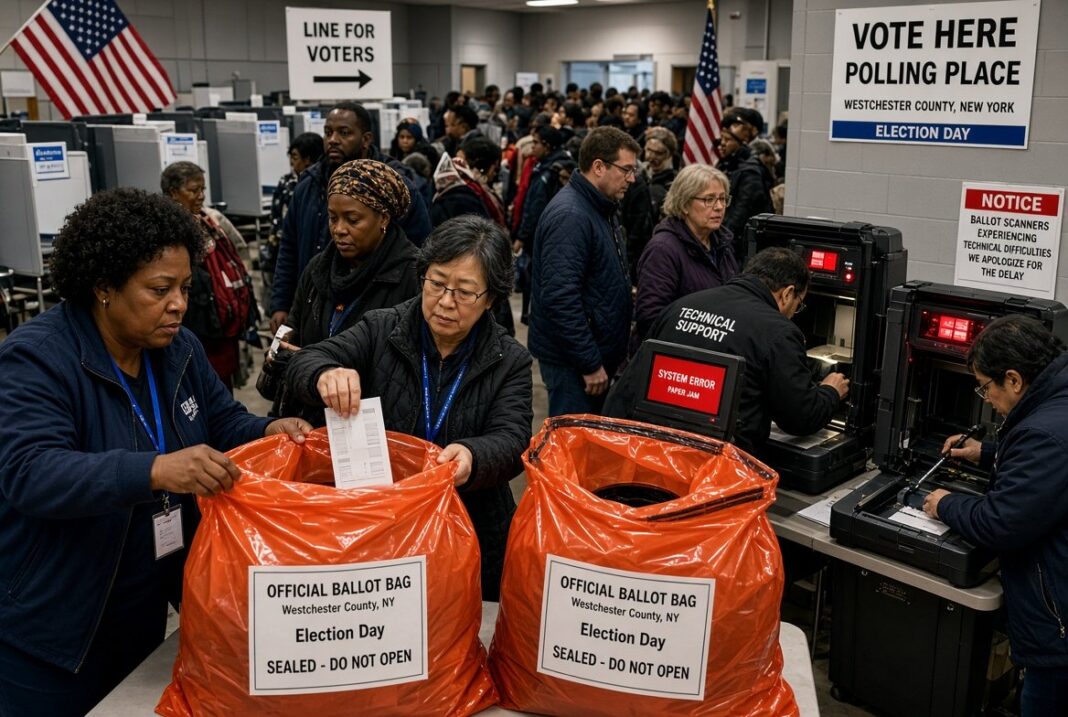
Voting machines across Westchester County rejected paper ballots because an election-programming update had not reached every machine. Voters could still cast ballots, which were secured in orange emergency bags for later scanning and counting.
Election Day in Westchester County produced one of those visuals that practically manufactures conspiracy theories on contact: voting machines rejected paper ballots, and poll workers began putting completed ballots into orange emergency bags. The actual explanation was much more bureaucratic and much less cinematic.
The New York State Board of Elections said the problem resulted from an update to Westchester County’s election programming that occurred after equipment had already been prepared and tested. Some machines had not received the update, so they rejected ballots that otherwise should have scanned normally.
Voters were still allowed to vote on paper. When scanners could not accept the ballots, poll workers placed them into secure emergency ballot containers to be transported and processed later under existing election procedures.
Those orange bags are not an improvised fix invented because somebody panicked at 8 a.m. Westchester’s own poll-worker manual specifically instructs officials to use orange security bags for completed emergency ballots that cannot be scanned, along with other categories of ballots requiring later handling.
The issue was especially sensitive because Westchester makes up a large portion of New York’s competitive 17th Congressional District. Any machine malfunction in a close House race is basically guaranteed to produce ten thousand social-media detectives before the Board of Elections has finished its first coffee.
Republican Rep. Mike Lawler publicly said there was no evidence of deliberate interference. Democratic candidate Cait Conley also urged people to stay in line and vote, while election officials and vendors worked to address the machines.
The New York State Board of Elections later warned that election-night results were incomplete because a significant number of Westchester emergency ballots had not yet been scanned. That is not the same as ballots being lost; it means the unofficial totals did not yet include ballots waiting for normal post-poll processing.
Officials initially floated ballot thickness as a possible cause before the state identified the programming update as the actual issue. Election administration occasionally has the same troubleshooting process as home Wi-Fi: blame the paper, blame the machine, then discover somebody forgot the update.
The important part is what did not happen. Voters were not turned away simply because a scanner rejected their paper ballot, and the affected ballots were preserved under procedures specifically designed for a machine failure.
That does not excuse the programming mistake, especially in one of the state’s highest-profile battleground counties. It does explain why the orange bags are evidence of the backup system operating, not evidence that ballots were being thrown into some mysterious election abyss.
The final counts will take longer because those ballots must be processed after the malfunction. In a close race, waiting is frustrating, but “count the ballots that the machines could not scan on Election Day” is considerably better than pretending they never existed.
Sources
- Axios — Westchester voting-machine issue forces emergency-ballot procedures
- New York State Board of Elections — Statement on Westchester programming update
- New York State Board of Elections — Unofficial results note excluding unscanned Westchester emergency ballots
- Westchester County poll-worker manual — Orange security pouch procedures for emergency ballots