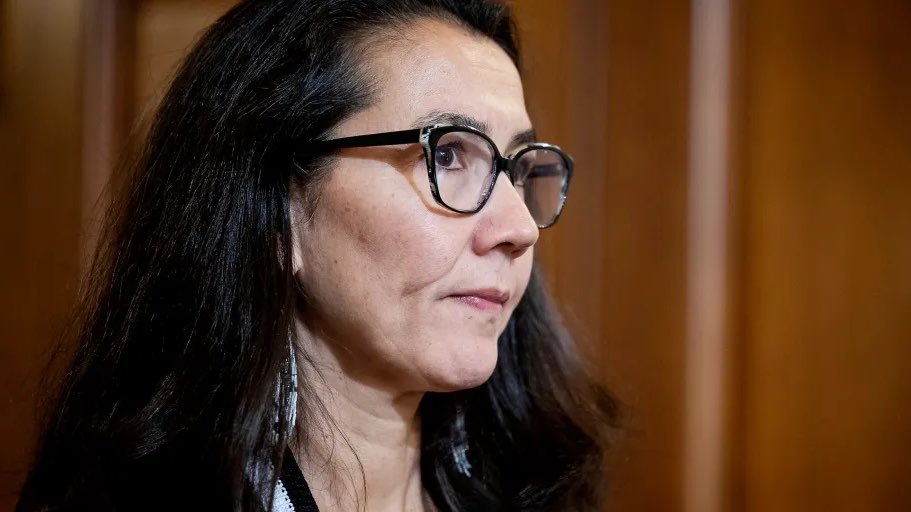





Erika Kirk is trying to run Turning Point USA while conspiracy theories pushed by former ally Candace Owens continue to consume parts of the conservative media ecosystem.
Running a political organization after its founder dies would be difficult under normal circumstances. Erika Kirk’s version is considerably less normal: she is trying to lead Turning Point USA while one of her late husband’s former allies keeps promoting conspiracy theories about his death to millions of followers.
Vanity Fair’s latest profile of Erika Kirk describes a conservative movement still struggling over Charlie Kirk’s legacy, with Candace Owens playing an unusually disruptive role. Owens once worked closely with Kirk at Turning Point and was part of the conservative media network that helped turn the organization into a national force.
After Kirk’s assassination in 2025, Owens began publicly questioning the official account of his death and promoting a series of unsubstantiated theories. Her speculation has involved alleged foreign actors, mysterious networks and supposed suspicious behavior by people close to Turning Point. There is no credible evidence establishing the broader conspiracies she has suggested.
Erika Kirk has repeatedly tried to push back. At one point she publicly told conspiracy theorists to stop. She later agreed to meet privately with Owens in an effort to lower the temperature, a decision that briefly looked like it might contain the dispute. It did not.
Owens continued discussing the theories afterward, while other conservative commentators began choosing sides. What started as internet speculation became an internal MAGA-media fight over credibility, loyalty and who gets to define Charlie Kirk’s legacy.
That is a particularly difficult problem for Erika because Turning Point is not merely a memorial project. It is a large political organization with donors, staff, events and influence inside Republican politics. Conspiracy theories about its founder’s death can therefore affect fundraising, internal trust and the public reputation of the organization she now runs.
The situation also exposes a structural problem inside influencer-driven politics. Traditional organizations can sometimes contain rumors through formal statements, lawyers and trusted media channels. Online political ecosystems are built around personalities whose business model often rewards suspicion, outrage and escalation. “Everyone calm down” is rarely the highest-performing thumbnail.
Owens’ reach makes that problem harder. She commands millions of followers and has built a brand partly by rejecting conventional institutions and presenting herself as someone willing to pursue questions others supposedly will not. To her audience, official denials can become evidence of a cover-up rather than a reason to move on.
That logic is difficult to defeat because it can absorb almost any contradiction. If Turning Point responds, the response is treated as suspicious. If it stays quiet, the silence is treated as suspicious. If Erika Kirk meets with Owens, the meeting itself becomes new material. Conspiracy culture has many strengths; reaching a natural stopping point is not among them.
Vanity Fair describes Erika as trying to preserve her husband’s political mission while also raising their children and managing the organization he founded. That would already be a high-pressure role. Doing it while a former family ally publicly questions the circumstances of his death adds a layer that no leadership handbook probably anticipated.
There is also a broader fight over ownership of Charlie Kirk’s legacy. Turning Point wants to institutionalize it through conferences, political organizing and youth outreach. Owens’ approach keeps the focus on unanswered questions and suspicions. Both claim in different ways to be defending the truth about someone they knew, which makes compromise unusually difficult.
The stakes go beyond personal drama because Turning Point remains an important part of conservative politics. It organizes young voters, runs major events and provides a platform for Republican figures. Internal feuds involving prominent influencers can therefore become factional fights affecting the wider movement.
That is where the story becomes more than celebrity gossip for political people. A movement built heavily through podcasts, livestreams and personality brands is discovering how hard it can be to control those same tools when former allies use them against one another.
The tragedy at the center of the story should not get lost. Charlie Kirk was killed, his widow inherited an enormous public burden, and unsubstantiated theories about his death continue circulating around her family and organization. The spectacle may be bizarre, but grief is not.
The strange part is how quickly that grief became another battlefield in the conservative attention economy. Erika Kirk is trying to run an institution. Candace Owens is still asking questions to an audience measured in millions. And somewhere in between those two realities sits a political movement trying to decide which version of loyalty counts.