




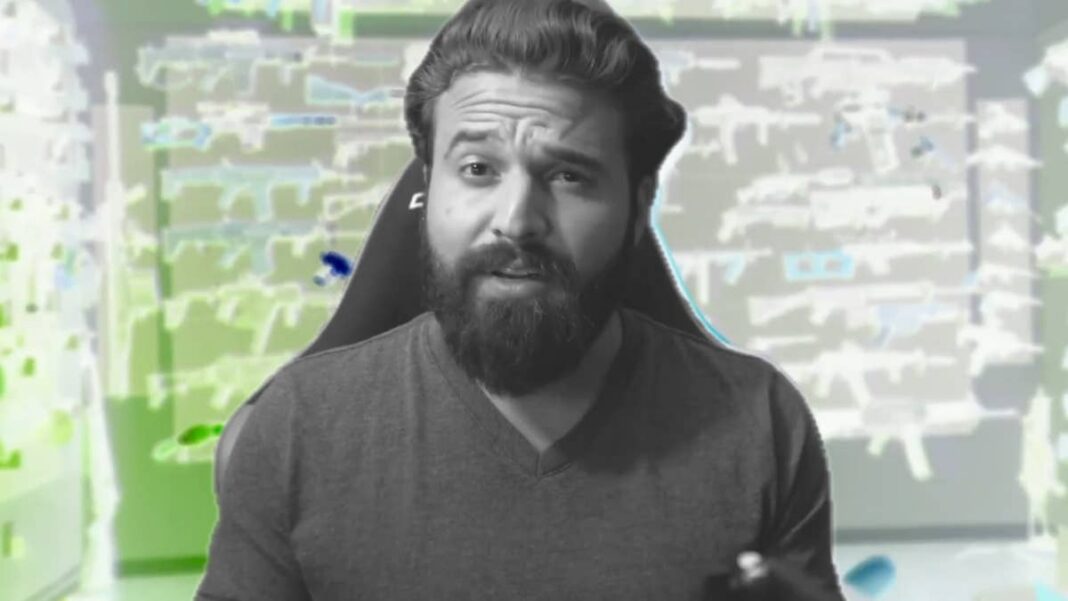
Brandon Herrera says his online persona is comedy. His years of deliberately provocative gun content are now colliding with a congressional race in a district that includes Uvalde.
Brandon Herrera built a massive online following by doing something the internet has rewarded for years: take an already provocative subject, turn the volume to maximum and never leave a joke on the table because it might make somebody uncomfortable. Now the gun YouTuber is the Republican nominee for Congress in a Texas district that includes Uvalde, and years of that content are being replayed outside the friendly confines of his subscriber base.
The Guardian reviewed Herrera’s videos and social-media history and documented a long list of deliberately inflammatory material, including Nazi references, jokes about firearm deaths, sexualized language about guns and a description of children as ‘cum trophies.’ Herrera has defended his style as comedy and has rejected the idea that offensive jokes should be treated as evidence that he embraces extremist beliefs.
That distinction matters. Making a Nazi joke is not the same thing as being a Nazi. Using grotesque language for comedic effect does not automatically reveal a candidate’s private ideology. But campaigns are also not YouTube channels, and voters are allowed to decide that a joke told for clicks says something about the judgment of the person telling it.
Herrera, known online as ‘The AK Guy,’ has more than four million YouTube subscribers and hundreds of millions of views. He built his brand around firearms, particularly extreme builds and hard-line Second Amendment commentary. His best-known project is the AK-50, an oversized rifle designed to fire .50-caliber ammunition. The basic content formula has been guns, spectacle and humor calibrated for an audience that does not mind crossing a few lines.
Some of those lines now look very different because of the district Herrera wants to represent. Texas’s 23rd Congressional District includes Uvalde, where 19 children and two teachers were killed at Robb Elementary School in 2022. The shooting became one of the most painful events in the national debate over guns, school safety and police response.
The Guardian highlighted Herrera’s rhetoric about children because of that context. In one instance, he referred to children using the phrase ‘cum trophies,’ language that his Democratic opponent, Katy Padilla Stout, has said is especially disturbing in a district where families are still living with the consequences of the Uvalde massacre.
Herrera has also made Nazi-related jokes in gun videos. The Guardian describes a 2022 video about the German MP 40 submachine gun in which he called it the ‘original ghetto blaster’ and later participated in a goosestep while a German military song played. Other past material has included jokes about deaths during the 2020 Kenosha unrest and a comment about putting a gun in his mouth that referenced veteran suicide.
His defense is that viewers familiar with his content understand the performance. In an interview with The New York Times referenced by the Guardian, Herrera described the persona as a comedy act. That explanation will probably make sense to some of his longtime followers, who see his brand as intentionally transgressive humor rather than a literal political manifesto.
The challenge is that congressional campaigns introduce a much larger audience, including people who have never watched a 20-minute gun video and have no interest in learning the internal grammar of edgy YouTube humor. A line that lands as an inside joke to subscribers can sound very different when printed on a mailer and delivered to a suburban voter who has never heard of ‘The AK Guy.’
Herrera also represents a broader change in Republican gun politics. The NRA once functioned as the dominant voice of the gun-rights movement. Years of financial and leadership turmoil weakened that position, while online creators and newer advocacy groups built audiences that are often younger, louder and more absolutist on the Second Amendment.
Herrera is almost a perfect product of that transition. He did not rise through a state legislature, a law firm or a conventional policy organization. He built an audience first, then converted that audience into political power. That route has obvious advantages in an era when attention is one of the most valuable campaign assets. It also means the archive comes with you.
Every candidate has opposition research. Influencers have searchable video libraries. Years of podcasts, clips, jokes, livestreams and social posts offer opponents thousands of opportunities to pull a candidate’s old content into a new setting. Herrera’s content is especially vulnerable because being offensive was often part of the product.
None of that resolves the policy issues in the race. Herrera can argue that he is a committed Second Amendment advocate whose opponents are trying to turn jokes into ideology. His critics can argue that the jokes themselves reveal poor judgment, particularly for somebody seeking to represent families in Uvalde.
What makes the story compelling is that both versions start with the same undisputed thing: Herrera said the words. The fight is over what voters should conclude from them. There is no need to inflate that into a claim that he secretly holds every belief referenced in every joke. The actual situation is strange enough.
A candidate seeking to represent a district associated nationally with one of America’s worst school shootings spent years building his celebrity through ultra-provocative gun content, and some of his most extreme material is now being introduced to voters who were never the intended audience. Herrera wanted attention. He got very good at getting it. The question now is whether the same material that built his brand online helps or hurts when the audience is no longer clicking ‘subscribe’ but choosing a member of Congress.
Where should voters draw the line between an entertainer’s deliberately offensive persona and the judgment they expect from someone holding public office?