



The federal government has spent at least $1.7 million airing Trump-focused television spots, including one based on a 2024 campaign ad. The White House insists they are legal public-service announcements.
The federal government has now spent at least $1.7 million airing television ads that prominently feature Donald Trump, praise his presidency and use rhetoric almost indistinguishable from his campaign messaging. The White House has an answer for anyone wondering whether taxpayers are funding political commercials: absolutely not, these are public service announcements.
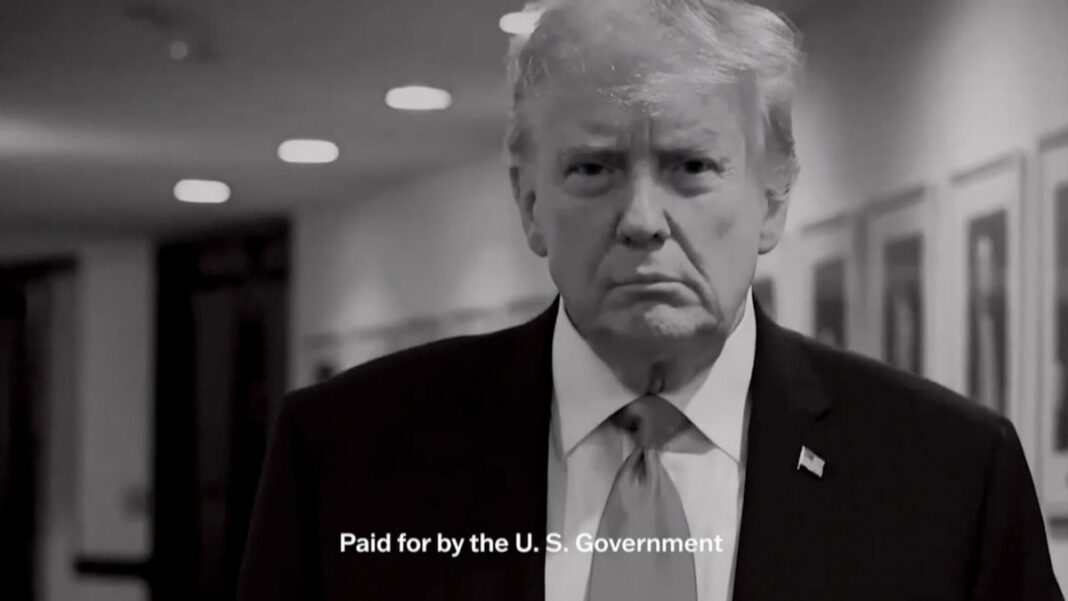
ABC News reports that the government has paid to air at least three Trump-focused television spots in recent days. One includes language about defeating communism, socialism and Marxism. Another uses imagery and language tied closely to Trump’s 2024 campaign. A newer ad features Trump talking about a “final battle” against the “deep state,” “globalists” and what he calls the “sick political class.”
That latest ad is especially striking because ABC and The Washington Post report that portions closely mirror a Trump campaign video from 2023 and 2024. The federal version uses the same monochrome aesthetic, similar footage and political language. The campaign-era ad was made to persuade voters to elect Trump. The taxpayer-funded version is being defended as government information.
At least the disclosure is not subtle. The ads include language indicating they were paid for by the U.S. government. AdImpact, which tracks political and television advertising, estimates the federal government has spent more than $1.7 million placing the spots across television, digital and connected-TV platforms.
The White House says the ads are educational, patriotic and lawful. Officials argue that administrations of both parties have long used taxpayer money for public-service campaigns, including government messages promoting Medicare benefits, Affordable Care Act enrollment and public-health programs.
Critics say those examples are not comparable because traditional PSAs generally explain a government program or ask the public to take a specific action. The Trump ads spend much of their time celebrating Trump personally and using overtly ideological language associated with Republican campaign messaging.
That disagreement creates a fairly simple test for the viewer. If an ad shows the president, praises his accomplishments, denounces the deep state and globalists and looks almost identical to his campaign material, at what point does calling it a PSA start sounding like calling a campaign rally a town-hall meeting because someone put a folding table near the entrance?
Democratic lawmakers and government-ethics experts have argued the ads may violate federal restrictions against using public money for propaganda or partisan political activity. Those are allegations and legal interpretations, not final court findings. No judge has ruled that the current ads are unlawful.
The Hatch Act and related federal rules prohibit certain uses of government resources for electoral activity, while separate appropriations restrictions bar taxpayer-funded propaganda. The exact legal question would depend on who created the ads, what agency money paid for them and whether their purpose is considered governmental communication or electioneering.
That last issue is where the White House is planting its flag. Trump is not personally on the ballot in the 2026 midterms, and the ads do not explicitly tell viewers to vote Republican. Administration officials argue that promoting the president’s policy agenda is part of legitimate government communication.
Critics respond that midterm messaging does not need to say “vote Republican” to function politically. Trump has repeatedly framed the election as a referendum on his presidency, and the ads use language nearly identical to material created for his campaign. To them, the absence of a direct voting instruction is a technicality rather than a meaningful distinction.
The scale is also growing. What began as a relatively small ad buy has expanded into millions of dollars in federal spending. The Washington Post reports that one recent commercial alone received more than $300,000 in television placement. Once government messaging reaches that level, the question stops being about a quirky White House video and becomes a budget issue.
There is a broader precedent at stake too. If one administration can use public funds to run ads that mirror campaign material while calling them public education, future presidents of either party could do the same. Republican lawmakers might feel differently if a Democratic president spent millions on government ads denouncing right-wing extremism while replaying footage from a campaign commercial.
That is usually the most useful way to evaluate executive-power arguments: imagine the other party controlling the button.
For now, the administration maintains the ads are legal PSAs. Critics call them taxpayer-funded political propaganda. The government is continuing to buy airtime while that argument plays out.
The practical question for taxpayers is simpler than the legal one. If a federal ad looks, sounds and feels like a campaign commercial, how different does it really need to be before the public should have to pay for it?