




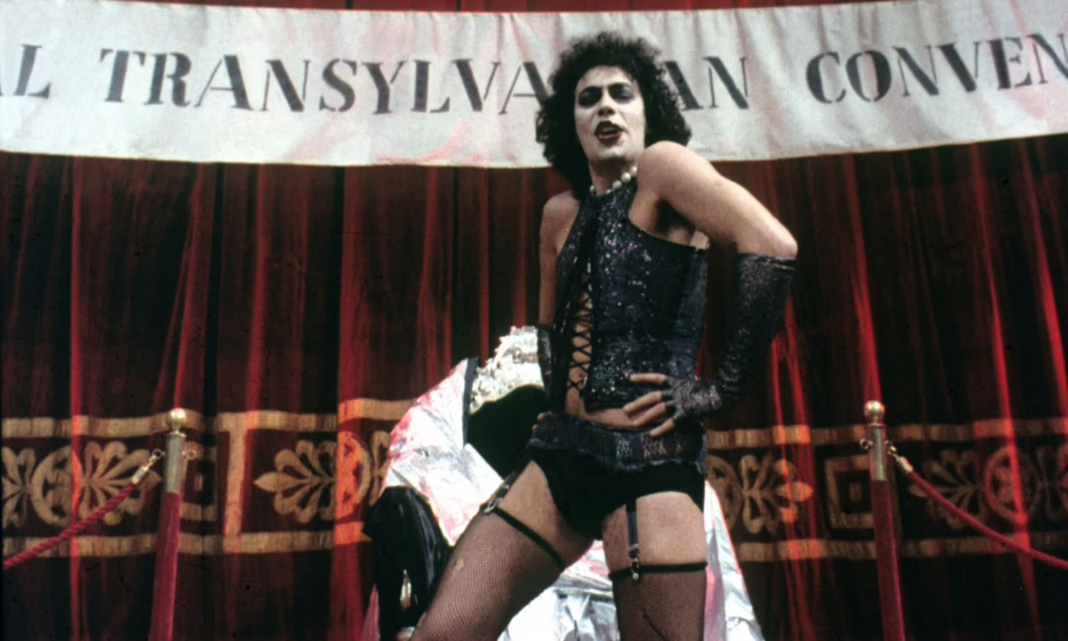
Tim Curry died this week at 80, and the tributes immediately proved something his career had been demonstrating for half a century. Very few performers get remembered for one role that permanently alters pop culture. Curry managed several. For some people he was Dr. Frank-N-Furter in “The Rocky Horror Picture Show.” For others he was Pennywise in the 1990 television adaptation of Stephen King’s “It.” For another generation he was the concierge in “Home Alone 2,” the Lord of Darkness in “Legend,” or Wadsworth sprinting through “Clue” while explaining a murder plot at the speed of a man who had been told the credits were already rolling. The Guardian reported that Curry died peacefully in Los Angeles, according to his manager. The cause was not disclosed. The remarkable part is how quickly the news became less about one famous role and more about how many different corners of popular culture suddenly had a reason to mourn him.
That range is easy to forget because “The Rocky Horror Picture Show” became so enormous. Curry originated Frank-N-Furter onstage in 1973 and carried the role into the 1975 film. The movie did not begin as an obvious institution. It became one through midnight screenings, audience participation and decades of people discovering that a musical could be camp, horror, comedy and a communal costume party at the same time. Curry was at the center of it. The Guardian’s Aug. 27 appreciation noted that his screen characters often lived on the line between serious and silly, with performances big enough to become instantly recognizable without collapsing into parody. That is a difficult trick. Plenty of actors can play strange. Curry made strange look completely certain of itself.
Then came the other impossible trick. He did not spend the rest of his career trying to reproduce Frank-N-Furter. He played Mozart on Broadway in “Amadeus,” earned Tony nominations for “My Favorite Year” and “Monty Python’s Spamalot,” terrified children as Pennywise, and became a prolific voice actor. The Guardian’s list of his best screen performances moved from “The Rocky Horror Picture Show” to “Clue,” “Legend,” “It” and “Muppet Treasure Island,” which is less a normal résumé than five separate careers accidentally sharing one face. Curry could disappear under horns, clown makeup or period costumes, then show up in a comedy and dominate a scene with an eyebrow. Modern entertainment likes performers who can anchor a brand. Curry kept behaving like the brand was whatever happened after he walked into the room.
That makes his death land differently in a culture now built around familiar intellectual property. Studios keep returning to recognizable titles because recognizable titles reduce risk. Broadway does the same thing with revivals. Streaming platforms are full of reboots, sequels and adaptations designed to arrive with an audience already attached. Curry himself is now being remembered while “Richard O’Brien’s Rocky Horror Show” is playing at Studio 54 in New York. The New York Post reported that the Broadway production is scheduled to run through Feb. 28, 2027. There is something fitting about that. Curry is gone, but one of the strangest things he helped make mainstream is still selling tickets in Manhattan more than 50 years after he first put on the corset.
The easy conclusion would be that Curry was irreplaceable. That is true in the boring sense that every distinctive performer is irreplaceable. The more interesting point is that the entertainment industry increasingly tries to replace the conditions that produced people like him. Curry built a career by moving among theater, film, television, comedy, horror, musicals and voice work. He was allowed to be theatrical in movies, sinister in comedy and funny while playing villains. The roles were often eccentric enough that a modern marketing department might ask which demographic they were supposed to be for. The answer turned out to be several generations. Curry did not fit neatly into a lane, so audiences kept finding new lanes for him.
That is also why the tributes have been unusually specific. People are not merely saying they liked Tim Curry. They are naming which Tim Curry got them first. The Frank-N-Furter people have one version. The Pennywise people have another. “Clue” fans can describe his physical comedy almost scene by scene. The Guardian’s Aug. 27 piece singled out the expressiveness of his face, noting how much of a performance he could generate from brows, lips and posture before dialogue did any work. That kind of specificity is what separates nostalgia from memory. Nostalgia says an era was better. Memory says one actor did something so particular that people can still picture the movement decades later.
There is plenty of sentimentality available when a beloved performer dies, and some of it is deserved. Curry also left behind something more useful than a warm retrospective. His career is a reminder that audiences often respond to the exact qualities entertainment executives are tempted to sand down. Too theatrical. Too strange. Too camp. Too menacing. Too difficult to categorize. Those were not defects to be managed. They were the work. “The Rocky Horror Picture Show” became a cultural institution because it did not resemble the safe middle of anything. Pennywise worked because Curry was willing to make the performance funny enough to become even more unsettling. “Clue” has endured because everyone involved committed to material that could easily have collapsed if anybody had acted embarrassed by it.
Now the industry gets to perform one of its favorite rituals. It will celebrate the singular artist after spending years optimizing for repeatable formulas. Curry will be described as unique, transformative and impossible to duplicate. Then another meeting will begin about extending an existing franchise. The contradiction is not malicious. It is just familiar. Pop culture loves originality most reliably after originality has already proven profitable for several decades. Curry’s career escaped that trap because he kept changing the terms before anyone could comfortably package him.
His death therefore leaves a surprisingly modern question behind. The movies, shows and stage roles will remain. “The Rocky Horror Picture Show” will continue playing. Pennywise will continue terrifying people who encounter the 1990 version of “It.” “Clue” will keep finding audiences who discover that a board-game adaptation can somehow contain one of the great comic sprints through a mansion. Curry’s work is not disappearing. What feels scarcer is the willingness to let a performer be that odd, that broad and that difficult to summarize before everyone knows whether the experiment will work.
If pop culture knows Tim Curry was unforgettable because nobody else behaved quite like him, why does it spend so much time trying to make everybody easier to replace?
Sources
The Guardian: ‘He could arch both eyebrows and curl his lips in every direction all at once’: Tim Curry’s five best screen roles
The Guardian: Tim Curry, star of The Rocky Horror Picture Show and Stephen King’s It, dies aged 80
New York Post: Pay tribute to legendary Tim Curry by seeing ‘Rocky Horror’ on Broadway