



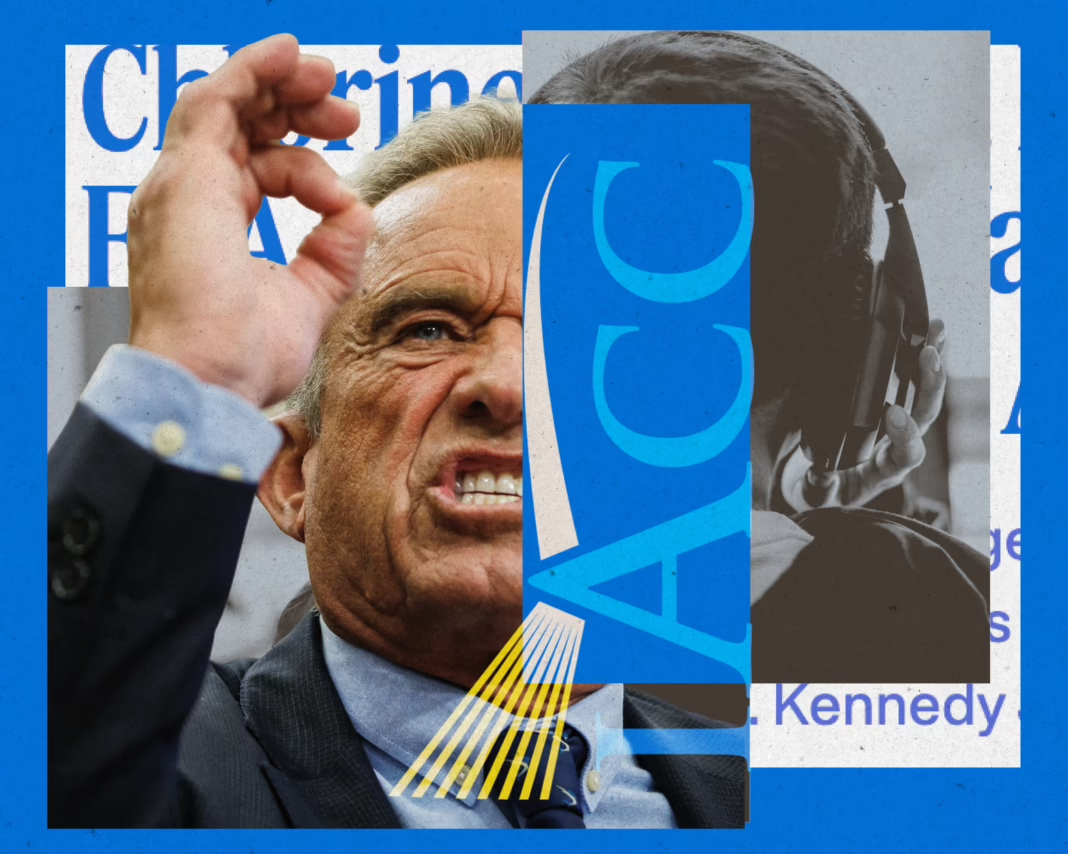
Robert F. Kennedy Jr.’s revamped federal autism advisory committee has produced a 336-page draft research roadmap, and scientists and disability advocates are alarmed by how much space it gives to disputed or weakly supported ideas. The Guardian reported that the plan shifts attention away from established genetic research and toward areas including folinic acid, chelation, fecal microbiota transplants and other approaches critics say lack adequate evidence. Federal research planning has apparently entered its brainstorm phase and forgotten that brainstorms are supposed to be edited.
The danger is not simply that a strange study gets funded. Research budgets create incentives. When Washington announces that a line of inquiry matters, universities, companies and advocacy groups respond. Money moves. Careers move. Families notice. A government that elevates weak evidence can make fringe treatments look officially promising long before the evidence earns that status. The seal on the document does some of the marketing automatically.
The Interagency Autism Coordinating Committee is meant to help shape federal priorities. According to The Guardian, critics also raised conflict-of-interest concerns about members with ties to companies or approaches that could benefit from the proposed research. The draft includes $15 million for folate biology studies and discusses communication methods and residential models that disability-rights advocates say could revive discredited or isolating practices. Some elements, including attention to support across the lifespan, drew praise. The fight is over what else is being smuggled into the research agenda beside it.
The target is Kennedy’s habit of treating institutional skepticism as a substitute for scientific hierarchy. There is value in questioning consensus. Science depends on it. But questioning everything does not make every answer equally plausible. A federal committee is not a suggestion box where chelation gets the same weight as decades of genetics research because somebody wrote passionately in the margins.
Kennedy and his allies often frame this kind of disruption as liberation from a captured scientific establishment. That argument is politically powerful because institutions do make mistakes and conflicts of interest do exist. The problem is that the cure for bad gatekeeping cannot be removing the gate and inviting every theory onto the runway. Evidence still has to discriminate. That is its job.
The draft is not final, and public and expert feedback can still change it. That matters. The committee has an opportunity to show that listening to unconventional ideas does not require pretending uncertainty is evenly distributed. Autism research is already an area crowded with anxious families, commercial promises and decades of misinformation. Federal policy should make that landscape easier to navigate, not add another booth to the fair.
Families affected by autism are particularly vulnerable to research hype because the stakes are personal and long term. A federal document does not land in an academic vacuum. It lands in parent groups, clinics, social feeds and markets already crowded with people selling certainty. That is why the government has a higher obligation to distinguish promising questions from speculative ones. Curiosity is not the same as endorsement, but official funding can make the distinction disappear for people who understandably want help now.
The committee’s defenders may argue that neglected ideas deserve study precisely because conventional research has not answered every question. That is reasonable up to a point. The problem is opportunity cost. Every dollar and every research team assigned to a weak hypothesis is a dollar and team not assigned somewhere else. Scientific pluralism still requires triage. Otherwise the federal research agenda becomes a catalogue of everything anybody has ever wanted tested, with taxpayers underwriting the sorting process.
The draft stage is therefore the moment when Kennedy’s committee can prove it understands the difference between disruption and indiscrimination. A serious revision would keep worthwhile attention on services, adulthood and quality of life while demanding stronger evidence before fringe interventions receive federal prestige. If the final plan instead treats skepticism of mainstream science as a qualification by itself, the committee will have answered the credibility question before the research begins.
The reason rfk jr.’s autism panel found room for nearly every fringe idea works as more than a one-day headline is that the underlying incentive does not disappear when the news cycle moves on. The people and institutions involved are being rewarded for a particular kind of behavior, whether that reward is attention, political loyalty, money, status or the comfort of avoiding a harder decision. That is the thread worth watching after the immediate controversy cools. A single episode can be dismissed as bad luck or bad optics. A repeated incentive becomes a governing or cultural habit. The useful test is not whether everyone involved can produce a defensible explanation. Most public controversies come with one. The useful test is whether the explanation would still sound reasonable if the names and teams were reversed. That is where satire earns its keep. It strips away the jersey and leaves the behavior sitting there by itself. The next development will matter because it will show whether this was an exception that embarrassed the people involved or a model they intend to keep using. If the same logic appears again, the story stops being an oddity and becomes a pattern. If the people involved change course, that is evidence too. That is why the closing question matters here: If federal autism research starts rewarding the loudest alternative theories instead of the strongest evidence, how much money and trust will be lost before the course changes? Public life is full of arguments about motives that cannot be proved. Behavior is easier to judge. Watch what gets repeated, what gets rewarded, what gets quietly abandoned, and who is asked to absorb the cost. Those details usually tell the story more clearly than the slogans do.
If federal autism research starts rewarding the loudest alternative theories instead of the strongest evidence, how much money and trust will be lost before the course changes?
Sources