




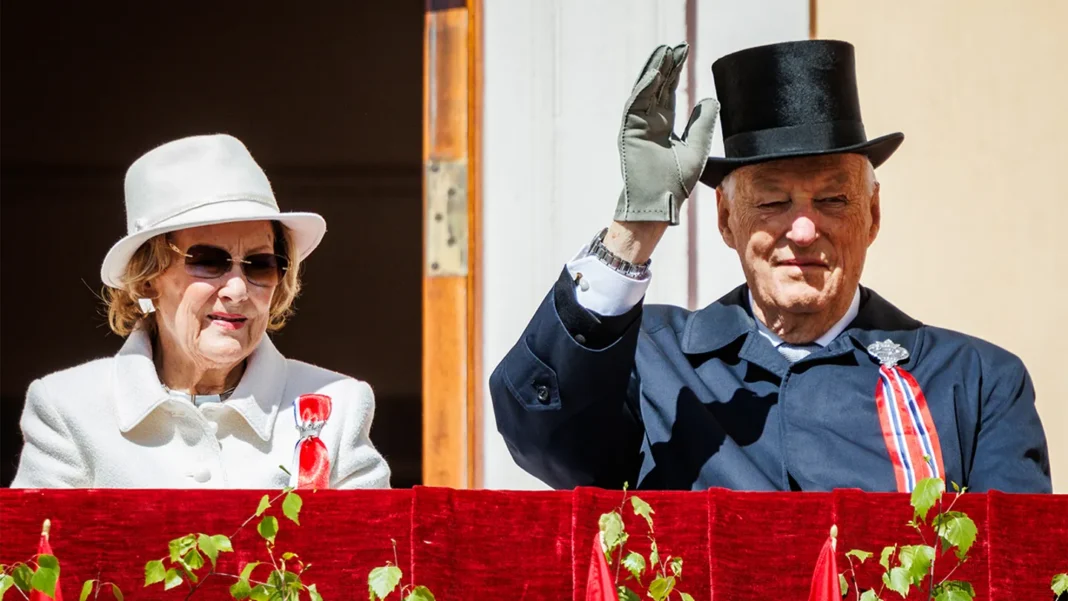
Norway woke Friday to the death of King Harald V at 89 and the immediate arrival of a new reign. The Royal House said Harald died peacefully at Oslo University Hospital at 6:35 a.m. after being hospitalized earlier in August. His son, Crown Prince Haakon, 53, is set to succeed him as King Haakon VIII. Monarchies specialize in making enormous transitions look like calendar maintenance. One king dies, another title changes, and the institution keeps moving before the flowers have arrived.
The target is not grief, and it is not Harald. It is the royal fantasy that succession itself can reset the institution. A crown changes heads in seconds. Public trust does not. Haakon becomes king with all the inherited advantages of monarchy and all the inherited complications of a family whose private relationships have become public liabilities. The job description says continuity. The news cycle says explain yourself.
Harald had been Norway’s head of state since 1991 and was Europe’s oldest reigning monarch. Fox News reported that he was viewed as a reformer who favored greater openness between royal families and the public. His own childhood carried an unusual American chapter. After Nazi Germany invaded Norway in 1940, Harald fled with his mother and sisters, eventually living in the United States and spending time around Franklin D. Roosevelt. A monarchy built on continuity was led for 35 years by a man whose early life had been violently interrupted by history.
The new king inherits something less ceremonial than a clean slate. Fox reported that Haakon and his wife, Mette-Marit, have faced scrutiny over her past contacts with Jeffrey Epstein. Mette-Marit has said she regrets those ties and has said she did not know the full nature of Epstein’s conduct at the time. Her son, Marius Borg Høiby, was convicted in June on rape and domestic-violence charges and sentenced to four years in prison, with appeals pending. Those are not footnotes a new monarch can wave away with a carriage procession.
That tension is built into modern monarchy. Royals are expected to be human enough to feel relatable and exceptional enough to justify the institution. Openness helped Harald modernize the Norwegian crown, but openness has a cost. Once the gate is open, the public does not only see weddings, uniforms and national-day balconies. It sees emails, associations, court cases and family decisions. Transparency is wonderful right up until it starts working.
Haakon now has to manage two kinds of inheritance at once. One is his father’s long reign and reputation for duty. The other is a set of controversies he did not create but cannot pretend are happening in another household. The first days of a reign are usually written in the language of continuity, service and national unity. Those words may all be sincere. They are also about to meet the less poetic business of credibility.
Norway’s monarchy has traditionally benefited from a political culture that expects royals to be restrained rather than theatrical. That makes the transition especially delicate. Haakon does not need to reinvent the crown on day one. He needs to preserve the sense that the institution is steadier than the controversies around the family. The difficulty is that modern audiences do not separate institutional and personal credibility as neatly as palaces would prefer. A king can insist that a relative’s conduct is private, but the public still sees the family name on the building.
Harald’s reputation for openness creates another challenge for his successor. Openness is easy to praise when it means accessibility, warmth and a monarch willing to speak plainly. It becomes harder when the same public expects direct answers about embarrassing associations. Haakon inherits the benefit of a crown that did not hide behind excessive mystique. He also inherits the expectation that silence cannot be the only response when the household becomes the story. That is the bargain of a modernized monarchy. You get to look less remote, but you lose some of the old distance that protected the institution from family mess.
The first phase of Haakon’s reign will therefore be judged on tone as much as policy or ceremony. Norway will mourn Harald and celebrate continuity. Then the ordinary questions will return. How does the new king talk about trust? How does the palace draw lines between public duty and private family problems? How much explanation is enough without turning the monarchy into a permanent press conference? Succession answers who wears the crown. It does not answer any of that.
The reason norway lost a king and inherited a much messier crown works as more than a one-day headline is that the underlying incentive does not disappear when the news cycle moves on. The people and institutions involved are being rewarded for a particular kind of behavior, whether that reward is attention, political loyalty, money, status or the comfort of avoiding a harder decision. That is the thread worth watching after the immediate controversy cools. A single episode can be dismissed as bad luck or bad optics. A repeated incentive becomes a governing or cultural habit. The useful test is not whether everyone involved can produce a defensible explanation. Most public controversies come with one. The useful test is whether the explanation would still sound reasonable if the names and teams were reversed. That is where satire earns its keep. It strips away the jersey and leaves the behavior sitting there by itself. The next development will matter because it will show whether this was an exception that embarrassed the people involved or a model they intend to keep using. If the same logic appears again, the story stops being an oddity and becomes a pattern. If the people involved change course, that is evidence too. That is why the closing question matters here: Can Haakon turn a moment of national mourning into a stable new reign while the scandals around his household remain unresolved?
Can Haakon turn a moment of national mourning into a stable new reign while the scandals around his household remain unresolved?
Sources
Fox News: Norway’s King Harald dies peacefully at 89, son Crown Prince Haakon to succeed him